
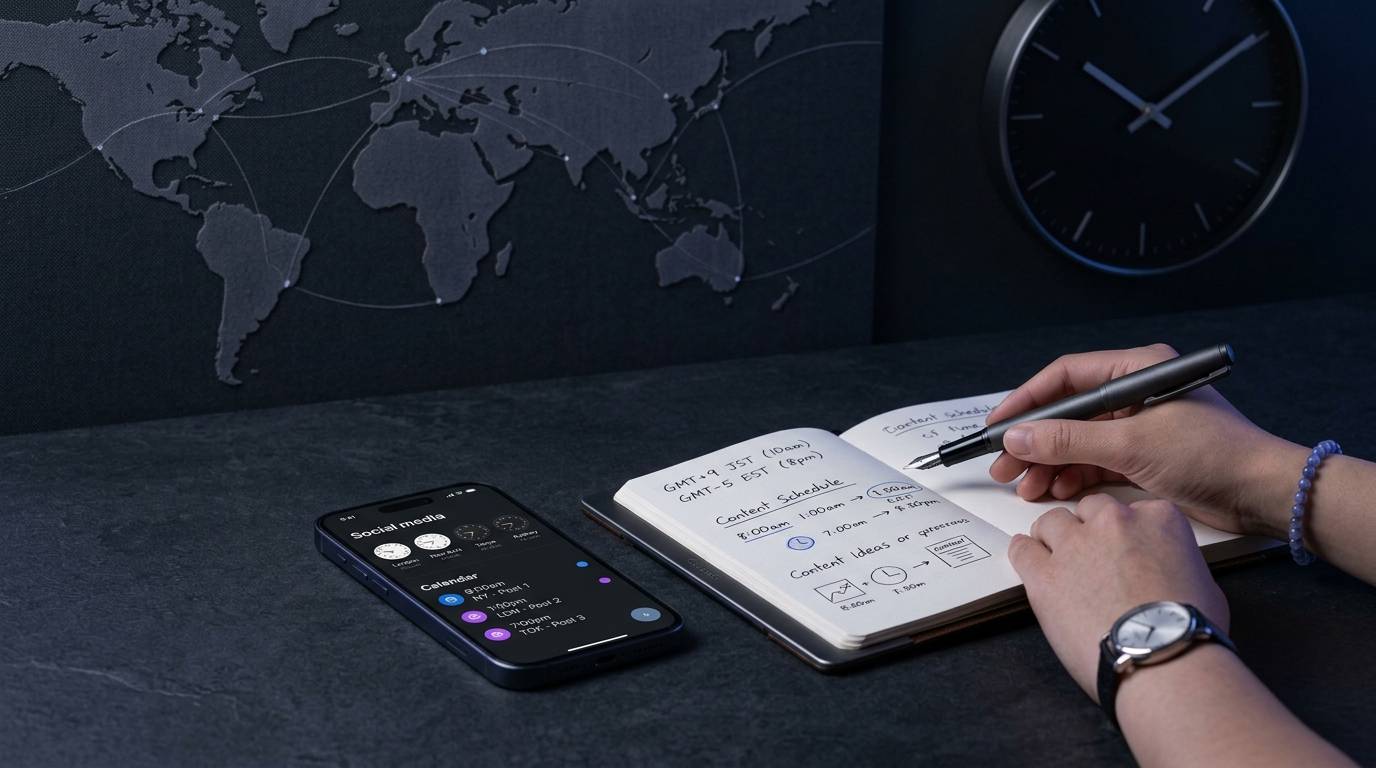
A marketing manager in New York schedules a product announcement for 9:00 AM, intending it for a morning audience in Tokyo. When the campaign goes live, the post appears at 9:00 AM Eastern time, reaching Tokyo at 11:00 PM while the local target market is asleep. The scheduler was set to the local browser time zone rather than the destination channel’s regional clock.
Publishing across multiple time zones requires clear systems, disciplined records, and explicit time standards. This guide explains how distributed social media teams coordinate international schedules, manage seasonal time changes, and prevent costly publishing mistakes.
A disciplined approach to global publishing requires separating local audience clocks from internal coordination timestamps. Teams that standardize date formats, verify scheduling software displays, and document handoffs can execute complex international campaigns without operational confusion.
Here are four core principles for cross-time-zone social publishing:
- Separate wall-clock time, UTC offsets, and location-based time zones in every publishing brief.
- Anchor recurring content schedules to named geographical locations rather than fixed numerical offsets.
- Maintain a market-facing calendar for audience timing and an operations-facing schedule for team handoffs.
- Treat third-party peak engagement studies as testable hypotheses rather than universal rules for every audience.
The core principles of timekeeping in social publishing
Managing content across borders begins with a clear vocabulary. Social media teams often run into trouble because they use the word time to mean three different concepts. Conflating these concepts leads to missed embargoes, premature announcements, and fragmented reporting.
To build a reliable publishing workflow, teams must distinguish between local wall-clock time, UTC offsets, and location-based civil time zones.
- Time Concept Hierarchy
-
- Local Wall-Clock Time: The visible clock face in a specific city (e.g. 09:00 in Paris).
-
- UTC Offset: The mathematical difference from Coordinated Universal Time (e.g. 02:00).
-
- Location-Based Time Zone: The legal civil rules governing offsets and seasonal changes (e.g. Europe/Paris).
Local wall-clock time
Local wall-clock time represents the actual hour and minute a person sees on a clock in their city. When a strategist requests a post at 9:00 AM in London, they are specifying a wall-clock time. Wall-clock time determines when an audience is commuting, taking a lunch break, or finishing work.
However, wall-clock time on its own contains no absolute geographic or chronological anchor. Stating that a post should go out at 9:00 AM does not tell a remote colleague or a scheduling tool when that moment occurs in relation to other regions.
Coordinated Universal Time and numerical offsets
Coordinated Universal Time, known as UTC, acts as the primary time standard by which the world regulates clocks. UTC does not change throughout the year and does not observe daylight saving time.
A UTC offset is the difference in hours and minutes between local civil time and UTC. Internet standards such as RFC 3339 define numerical offsets as local time minus UTC. To convert local time to UTC, you subtract the offset. For example, 18:50 at UTC-04:00 corresponds to 22:50 UTC.
UTC provides an unambiguous reference point for distributed teams. When an engineering team or a remote social team schedules a coordinated global moment, such as a software launch or an investor announcement, UTC ensures every contributor references the exact same instant.
Location-based time zones
A time zone is a geographic area governed by a specific set of civil time laws. Unlike a static UTC offset, a location-based time zone includes the historical, current, and future rules for clock transitions, including daylight saving time.
The Internet Assigned Numbers Authority, known as IANA, maintains the global Time Zone Database. The IANA database tracks regional boundary adjustments, daylight saving shifts, and political changes to civil time. For example, the time zone identified as America/New_York describes all the legal rules that govern civil time in that region, shifting between standard time and daylight saving time as mandated by law.
When planning recurring content, teams must anchor schedules to location-based zones rather than fixed offsets. A fixed offset such as UTC-5 describes a mathematical snapshot. A location-based zone describes an enduring civil environment.
Why seasonal clock changes break scheduling workflows
Seasonal clock transitions represent one of the most common failure points in multi-region publishing. When countries move between standard time and daylight saving time, relative time differences between global offices and target markets shift.
According to the National Institute of Standards and Technology, local time zones are expressed as offsets from UTC, but UTC itself never shifts for daylight saving time. In the United States, Eastern Standard Time is UTC-5, while Eastern Daylight Time is UTC-4.
- Seasonal Offset Shifts
- US Eastern Standard Time (EST): UTC-5
- US Eastern Daylight Time (EDT): UTC-4
- British Summer Time (BST): UTC 1
- Greenwich Mean Time (GMT): UTC 0
Asynchronous transition dates
Different countries adjust their clocks on different dates throughout the year. The United States typically adjusts its clocks in early March and early November. The European Union and the United Kingdom usually make their transitions in late March and late October. Many countries in the southern hemisphere adjust clocks in opposite directions, while equatorial nations often do not observe daylight saving time at all.
This asynchronous movement creates temporary windows where the time difference between two markets expands or contracts. For several weeks in the spring, the difference between New York and London shrinks from five hours to four hours. A team scheduling posts during this window using fixed assumptions will publish content an hour too early or an hour too late.
The repeated hour and skipped hour
Daylight saving adjustments create chronological anomalies that can confuse scheduling software. In the spring, civil clocks skip forward, leaping directly from 1:59 AM to 3:00 AM. In the autumn, civil clocks move backward, repeating an entire hour.
National Institute of Standards and Technology documentation explains that when daylight saving time ends in the United States, the local clock moves from 2:00 AM back to 1:00 AM, causing the 1:00 AM hour to occur twice on the same calendar day.
If a scheduled post is programmed for 1:30 AM during a fall transition, an automated system might publish during the first iteration of that hour, the second iteration, or encounter an error. To prevent double posts or missed publishing windows, teams should avoid placing critical automated posts inside the transition hour.
Changing political time zone rules
Time zone rules are not permanent physical constants. Governments periodically change daylight saving policies, alter municipal time zone boundaries, or abolish seasonal clock shifts entirely.
The IANA Time Zone Database receives regular updates to incorporate these political decisions. Social media managers coordinating long-term campaigns must track whether their scheduling tools and operating systems have updated their local zone definitions ahead of national policy changes.
Structuring a time-zone-aware publishing record
Preventing scheduling errors requires structured documentation. When social media managers rely on informal messages or ambiguous calendar entries, cross-market publishing mistakes multiply. A time-zone-aware publishing brief defines the audience context and the technical execution parameters before content enters the publishing queue.
Using a dedicated social media calendar allows teams to visualize publication dates across distinct regional channels while preserving market-specific contexts.
- Core Fields for a Time-Zone-Aware Record
- Target Market and Regional Channel
- Intended Local Wall-Clock Time
- Named IANA Time Zone (e.g. Europe/London)
- Operational UTC Timestamp (RFC 3339)
- Assigned Regional Owner and Approver
- Content Classification (Fixed vs. Queue)
- Contingency Contact and Escalation Path
Essential fields for cross-market briefs
Every publishing brief or scheduled entry should include seven explicit fields:
- Target market or channel: The specific regional account or audience segment intended to receive the post.
- Intended local publication time: The wall-clock date and time when the audience should see the content.
- Named time zone: The official city or IANA zone associated with the channel, such as Europe/Paris or America/Chicago.
- Operational UTC timestamp: The exact conversion written in RFC 3339 format, such as
2026-10-20T13:00:00Z, for shared team visibility. - Ownership and approvals: The specific team members responsible for content creation, localization, review, and final approval.
- Scheduling classification: Whether the post is fixed to a rigid moment or flexible within a recurring queue.
- Contingency contact: An identified team member available during the live publishing window in case of technical issues.
The market calendar versus the operations calendar
Complex global operations benefit from maintaining two distinct operational perspectives. Teams should separate audience-facing schedules from internal production schedules.
The market calendar answers the question: When will the audience see this content? It displays posts arranged by the target market’s local wall-clock time. A regional marketing manager uses this view to confirm that a promotion appears during peak morning commute hours in Berlin.
The operations calendar answers the question: Who must act, and when? It displays deadlines, approval handoffs, and publication triggers in UTC or the operator’s local working hours. A copywriter in San Francisco uses this view to ensure copy is approved before their European colleagues begin publishing.
Queue scheduling versus fixed-time publishing
Modern publishing software offers two distinct methods for scheduling content: automated queue slots and custom date-and-time settings. Understanding when to use each method is vital for managing multi-region content without disrupting carefully planned timelines.
When managing multiple social media accounts across different territories, misapplying queue mechanics can cause international posts to shift unexpectedly.
- Scheduling Method Selection
- Fixed Date and Time
- Product Launches
- Embargoed Announcements
- Live Event Coverage
- Coordinated Global Moments
- Automated Queue Slots
- Evergreen Educational Posts
- Repurposed Media Assets
- General Brand Awareness
- Non-Time-Sensitive Content
How queue scheduling operates
A publishing queue relies on pre-configured time slots assigned to a specific social channel. For example, a brand might set their UK LinkedIn Page to publish content automatically every weekday at 8:30 AM, 12:30 PM, and 5:00 PM London time.
When a team member adds a post to the queue, the platform assigns it to the next available empty slot. The software manages the timeline automatically.
However, queue slots are dynamic. Help documentation from publishing platform Buffer shows that changing a channel’s underlying posting schedule automatically rearranges queued posts into the newly configured slots. If an operator adjusts the weekly cadence, every queued post downstream will shift its publication time.
How custom fixed-time scheduling operates
Custom date-and-time scheduling bypasses the automated queue entirely. The operator selects an exact date, hour, and minute for a specific post.
According to platform documentation from Buffer, posts scheduled for a custom date and time remain locked to their assigned moment, even if the general channel posting schedule is modified or deleted. The post exists independently of the queue.
Choosing the right scheduling method
Teams should establish strict operational criteria for selecting between queues and fixed schedules:
- Use fixed scheduling for time-critical content: Product launches, legal notices, embargoed press releases, and live event tie-ins must be scheduled with specific dates and times. This protects the content from accidental displacement if a colleague adjusts channel settings.
- Use queue scheduling for evergreen content: Educational tips, brand stories, customer quotes, and evergreen media assets work best in automated queues. Queues allow regional managers to maintain an active channel cadence without manually plotting every timestamp.
When setting up broad initiatives with our campaign launch planner, separating fixed milestones from flexible support posts ensures launch announcements publish reliably on time.
Step-by-step process for multi-region publishing
Executing an international social publishing campaign requires a systematic workflow. Following a documented sequence prevents errors caused by miscalculated offsets, misconfigured browser settings, or untracked daylight saving transitions.
- Multi-Region Publishing Workflow
- Step 1: Define Target Audience and Market Parameters
- Step 2: Assign Official Location-Based Time Zones
- Step 3: Establish Operational UTC Timestamps
- Step 4: Select Fixed or Queue Publishing Mode
- Step 5: Verify Interface Display Against Channel Configuration
- Step 6: Execute Daylight Saving and Transition Checks
- Step 7: Conduct Formal Regional Operational Handoffs
Step 1: Define audience parameters and local objectives
Identify the exact geographic market for each piece of content. Determine whether the campaign requires a unified global moment, where every market sees the post at the exact same instant, or a staggered rolling release, where each market sees the post at 9:00 AM local time.
Document the target audience’s language, local cultural context, and expected daily routine.
Step 2: Assign location-based scheduling zones
Map each target account to its formal IANA time zone. Avoid short abbreviations like CST or BST, which can refer to multiple global locations.
Assign named regional identifiers, such as Asia/Tokyo, Europe/London, or America/Los_Angeles. Configure each channel within your publishing platform to reflect its local operating zone.
Step 3: Establish operational UTC reference timestamps
Convert each planned local publication time into an RFC 3339 UTC timestamp. This creates an unambiguous operational record for distributed teams.
Record the UTC conversion in the central campaign documentation. This step ensures that copywriters, designers, and compliance approvers working in different time zones know their exact production deadlines.
Step 4: Select the publishing mode
Determine whether each post requires a fixed timestamp or an open queue slot. Apply fixed scheduling to all campaign launch announcements, media partnerships, and coordinated events.
Assign evergreen and background content to regional queue slots, ensuring slots align with local daytime hours.
Step 5: Verify interface displays and channel settings
Inspect scheduled drafts within your publishing platform. Distinguish between how the software displays dates to the user and how the software executes publishing in the backend.
As documented in Buffer’s help guidance, a calendar interface may display scheduled times converted to the operator’s local browser clock, even while the channel remains configured to publish in its native regional zone. Always verify the underlying channel settings rather than trusting visual calendar placement alone.
Step 6: Conduct seasonal transition audits
Review the publication calendar two weeks before any anticipated daylight saving change. Identify posts scheduled in markets undergoing seasonal transitions.
Confirm whether your publishing software updates offsets automatically based on IANA data. Adjust custom fixed timestamps if an offset shift impacts coordination with other regional channels.
Step 7: Complete the operational handoff
Transfer monitoring and community management duties to the incoming regional team. Document the status of live posts, scheduled queues, and pending approvals.
Ensure the incoming team has access to escalation contacts and emergency pause protocols.
Managing global team handoffs and follow-the-sun operations
Organizations operating across multiple continents often use a follow-the-sun operational model. In this framework, active management of social channels passes sequentially between regional hubs across Asia-Pacific, Europe, the Middle East, Africa, and the Americas.
Industry research on international social media operations shows that a structured regional sequence, passing responsibilities from APAC to EMEA to the Americas, enables continuous publishing, real-time community engagement, and responsive crisis management.
- Follow-the-Sun Operational Flow
- APAC Hub: Sydney / Singapore / Tokyo
- (Handoff 1: 07:00 UTC)
- EMEA Hub: London / Berlin / Dubai
- (Handoff 2: 15:00 UTC)
- Americas Hub: New York / San Francisco / São Paulo
- (Handoff 3: 23:00 UTC)
- APAC Hub: Resumes Active Control
Defining clear service-level agreements
A follow-the-sun model requires formal service-level agreements between operating teams. Unclear expectations lead to dropped tasks, unapproved drafts, and delayed responses to audience inquiries.
Teams should define three core operating standards:
- Publishing verification window: The incoming team must verify all automated posts scheduled during their shift within 30 minutes of taking control.
- Community engagement response time: Standard response thresholds for customer inquiries, comments, and direct messages across active hours.
- Escalation response threshold: Maximum allowable time to acknowledge and escalate high-risk brand mentions or unexpected publishing failures.
Structuring the shift handoff record
Every regional handoff should include a written operational summary. Relying on casual chat messages risks omitting critical context.
A complete handoff record includes four operational components:
- Published content summary: Links to posts published during the concluding shift, accompanied by early performance notes or unusual engagement spikes.
- Upcoming scheduled queue: A review of posts set to publish during the incoming team’s shift, confirming that copy, media assets, and tracking links are approved.
- Active community conversations: Flagged audience inquiries, customer support tickets, or influencer interactions that require ongoing monitoring.
- Contingency flags: Known product issues, website outages, or breaking news events that might require pausing scheduled content.
Emergency pause protocols
When an unexpected crisis occurs, global teams must be able to halt publishing instantly across every account. A fragmented team with unclear permissions risks publishing lighthearted marketing messages during a serious brand emergency.
Maintain a documented emergency kill switch procedure. Every regional team lead must hold administrative authority to pause all scheduled queues globally. Document the emergency protocol in an accessible repository, specifying the communication channels used to notify leadership when an emergency pause is initiated.
Testing local publishing windows and interpreting engagement data
Social media managers frequently consult third-party studies to identify the best time to publish content. While industry research offers useful baseline data, global publishers must treat external benchmarks as testable hypotheses rather than universal rules.
When reviewing channel performance, knowing how to read social analytics helps teams evaluate engagement patterns across individual markets without drawing false conclusions.
- Testing Framework for Regional Publishing
-
- Baseline Hypothesis: Consult platform research for general regional windows.
-
- Market Segmentation: Group audience data by specific city or country cohorts.
-
- Controlled Experiments: Test identical formats across staggered local time slots.
-
- Iterative Optimization: Adjust scheduling configurations based on native data.
Analyzing industry timing research
Industry benchmarks reflect aggregated engagement trends across large data sets. For example, Sprout Social’s research on TikTok publishing analyzed over 2 billion engagements across 307,000 global profiles and 30,000 customer accounts between November 2025 and February 2026.
The study presented its findings in local wall-clock time, identifying Tuesdays through Thursdays between 2:00 PM and 6:00 PM local time as the most consistent high-engagement window across its analyzed sample. Their specific daily findings highlighted Tuesday from 2:00 PM to 6:00 PM, Wednesday from 1:00 PM to 8:00 PM, and Thursday from 1:00 PM to 5:00 PM as peak periods.
These findings provide an excellent starting point for experimentation. However, because the data aggregates thousands of disparate brands, the findings describe broad macro patterns rather than a guaranteed formula for an individual account.
Why global averages mislead regional strategies
Applying a single global engagement window across every regional channel creates severe operational blind spots. A peak publishing window calculated from a worldwide dataset often reflects the geographic concentration of the study’s largest participant cohort, which is frequently North America.
If an account’s audience is concentrated in Southeast Asia, publishing at 2:00 PM Eastern Standard Time means content goes live at 3:00 AM in Singapore. The post will miss active daytime feeds, accumulate little initial engagement, and perform poorly under algorithmic distribution models.
Designing market-specific timing experiments
To discover the most effective publishing windows for a specific brand, social teams should conduct disciplined local experiments:
- Segment analytics by territory: Use native platform analytics to identify where active followers actually reside. Determine whether the primary audience is concentrated in a single time zone or dispersed across multiple continents.
- Formulate a specific local hypothesis: Select a target market and test a specific two-hour window in that market’s local wall-clock time.
- Maintain content consistency: Test identical content formats, such as short-form video or image carousels, across different time slots to ensure creative differences do not skew the data.
- Measure baseline metrics over time: Track impressions, reach, and interaction rates over a minimum four-week testing period before making permanent changes to channel posting schedules.
Modern publishing tools allow teams to configure format-aware schedules tailored to the native behavior of each target network.
Common time-zone publishing pitfalls and how to avoid them
Operating across multiple time zones introduces recurring technical and organizational hazards. Recognizing these pitfalls enables teams to build safeguards before mistakes impact live campaigns.
- Common Publishing Mistakes and Mitigations
- Interface Assumption Pitfall
- Mistake: Assuming calendar view matches channel execution time.
- Mitigation: Verify underlying channel time zone settings directly.
- Ambiguous Abbreviation Pitfall
- Mistake: Writing shorthand like “CST” or “BST” in briefs.
- Mitigation: Use full IANA city names and explicit UTC offsets.
- Static Offset Pitfall
- Mistake: Using fixed offsets for recurring weekly content.
- Mitigation: Anchor recurring schedules to location-based zones.
- Universal Timing Pitfall
- Mistake: Applying global “best times” to regional accounts.
- Mitigation: Run localized timing experiments for each target market.
Assuming calendar display reflects publishing time
A frequent source of human error occurs when operators assume that the time displayed on their publishing calendar matches the time zone configured for the social channel.
Platform help documentation from Buffer explicitly notes that its calendar interface can display scheduled posts using the operator’s local browser time zone, even when the underlying channel is configured to publish according to a different regional clock.
For instance, a London-based channel scheduled to publish at 9:00 AM GMT will display as 4:00 AM on a calendar viewed by a colleague in New York. A reviewer who does not understand this interface behavior might assume the post was scheduled incorrectly and alter the time, breaking the regional strategy. Teams must train contributors to check channel settings directly rather than evaluating timestamps purely from calendar displays.
Relying on ambiguous time zone abbreviations
Using three-letter abbreviations such as CST, IST, or BST in campaign documentation creates dangerous ambiguity.
The abbreviation CST can refer to Central Standard Time in North America (UTC-6), China Standard Time (UTC+8), or Cuba Standard Time (UTC-5). Similarly, IST can mean Indian Standard Time (UTC+5:30), Irish Standard Time (UTC+1), or Israel Standard Time (UTC+2).
Standardize all campaign briefs around full IANA city names, such as Asia/Shanghai or America/Chicago, accompanied by numeric UTC offsets.
Using fixed UTC offsets for recurring seasonal posts
When teams configure recurring editorial schedules using fixed UTC offsets, those schedules will shift relative to the audience’s local routine when seasonal time changes occur.
NIST documentation illustrates that while Eastern time moves between UTC-5 and UTC-4, UTC itself remains static. If a brand configures a weekly post to publish at 14:00 UTC year-round, the content will reach New York at 9:00 AM during standard time, but will arrive at 10:00 AM during daylight saving time.
Anchor all recurring schedules to location-based civil time zones so that publishing software automatically adjusts execution when local clocks shift.
Treating queue slots as locked appointments
Social media managers often place launch-critical content into regular queue slots, assuming the post will publish at the currently displayed time.
However, modifying a channel’s overall weekly posting schedule automatically recalculates and shifts queued posts. If a team member adds a new queue slot or alters existing cadence, critical announcements can shift hours away from their intended windows.
Always use custom fixed-date scheduling for launches, embargoes, and coordinated campaign moments.
Platform nuances and technical execution quirks
Social media networks and third-party publishing platforms process time parameters differently. Understanding these technical nuances prevents unexpected publishing failures across connected accounts.
- Platform Architecture Nuances
- API Timestamp Processing: Networks accept absolute UTC timestamps and convert locally.
- Native vs. Third-Party Scheduling: Native tools often lock to account admin time zones.
- Channel-Level vs. Workspace-Level Settings: Schedulers vary between global and local clocks.
- Daylight Saving Adjustments: Most enterprise APIs update offsets using IANA tables.
How social platform APIs handle timestamps
Major social platforms, including Meta, TikTok, LinkedIn, YouTube, X, and Pinterest, process scheduling commands through developer APIs using standardized UTC timestamps.
When a third-party publishing workspace sends a scheduling instruction to an API, it transmits an RFC 3339 formatted timestamp, such as 2026-05-12T14:30:00Z. The receiving platform converts that UTC instant into the corresponding local time for display on the public feed.
Because APIs operate on absolute UTC values, conversion errors typically originate inside the scheduling interface or the user’s manual configuration, rather than within the social network’s ingestion engine.
Native platform tools versus third-party workspaces
Scheduling content directly inside native platform interfaces, such as Meta Business Suite, TikTok Studio, or LinkedIn Campaign Manager, presents unique operational challenges for multi-region teams.
Native tools often default to the time zone of the administrative user creating the post or the primary time zone assigned to the ad account. When distributed team members share native access, one contributor may schedule content in Pacific Time while another schedules in Central European Time.
Third-party publishing workspaces mitigate this confusion by standardizing channel configurations. A centralized workspace allows administrators to assign dedicated regional time zones to each connected profile, ensuring consistent execution regardless of where individual team members log in.
Verifying time-zone behavior across tools
Different publishing tools employ different design philosophies for managing time:
- Channel-specific time zones: Platforms like Buffer allow operators to assign a unique time zone to every connected social profile, ensuring that each channel publishes according to its local market clock.
- Workspace-level time zones: Some software suites enforce a single master time zone across the entire organizational account. In these systems, publishing to an international market requires manual mathematical offset calculations for every post.
- Automatic daylight saving compensation: High-quality scheduling platforms incorporate automated IANA updates, adjusting channel offsets seamlessly during seasonal transitions.
Teams should audit their publishing stack to understand whether their tools apply channel-level or workspace-level time rules, and verify how those systems handle seasonal transitions.
When to revisit this resource
Review and update your time-zone management protocols under the following circumstances:
- When expanding social media operations into new international geographic markets.
- Two weeks prior to spring and autumn daylight saving transitions in key operating regions.
- When onboarding distributed team members, remote agencies, or international community managers.
- Following any announced legislative change to time zone boundaries or daylight saving rules in target countries.
- When migrating to a new social media publishing tool or altering existing channel configurations.
Managing publishing across time zones requires moving from informal assumptions to rigorous operational standards. By anchoring recurring schedules to location-based zones, using unambiguous UTC timestamps for team coordination, and testing audience windows with market-specific data, global social teams maintain complete control over their international publishing.