
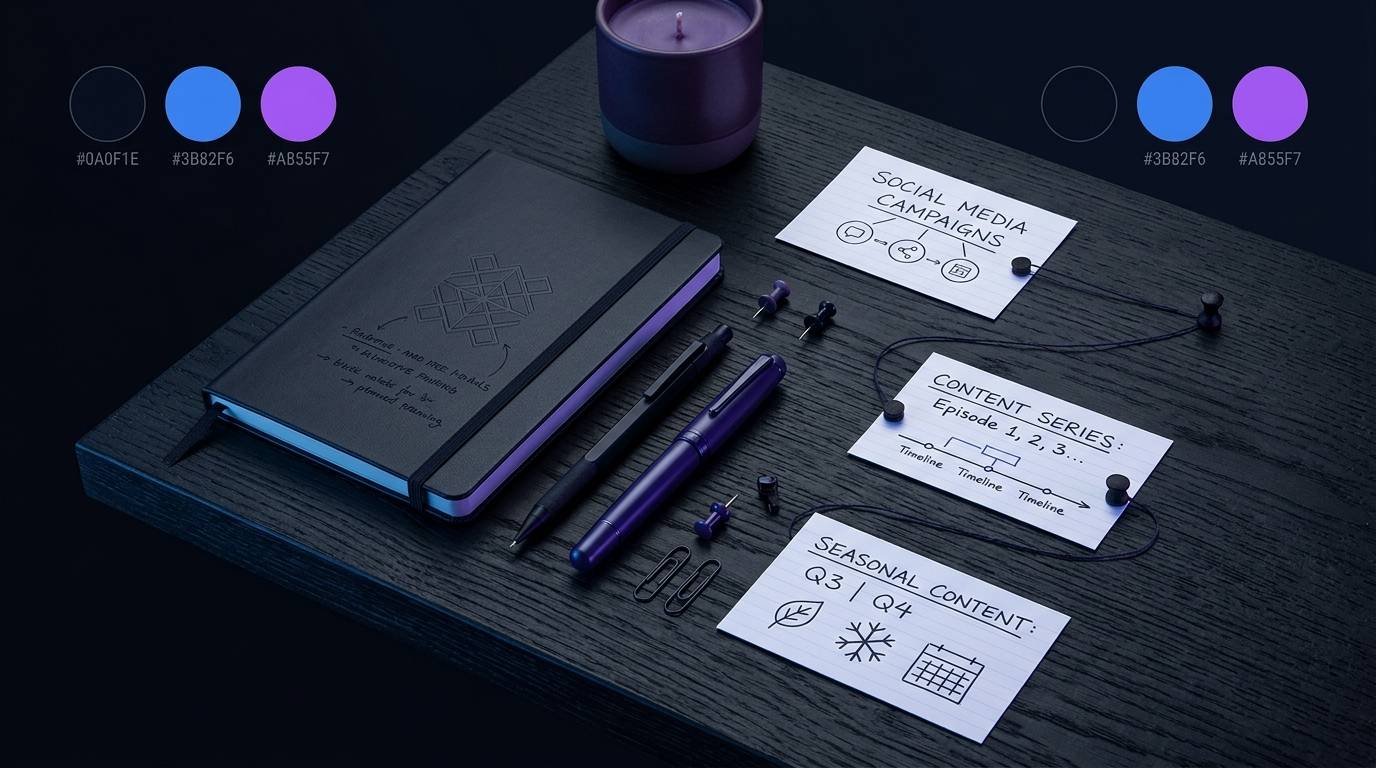
Social media managers often search for how to coordinate recurring series, seasonal moments, and major product campaigns without cluttering their publishing queue. When every initiative competes for the same calendar slots, teams face overlapping messages, missed dependencies, and burned-out creators.
This guide provides a comprehensive operational framework to plan, sequence, and execute complex social media schedules across multiple accounts and formats. By establishing structured lead times, reusable briefs, and collision controls, your team can maintain steady publishing velocity without sacrificing quality or strategic alignment.
A unified social planning system connects high-level business goals to daily execution by separating strategic, campaign, and publishing horizons into distinct workflows. Implementing structured lead times, explicit role ownership, and collision checks ensures that recurring series, seasonal activations, and product campaigns support rather than derail one another.
Key Takeaways
- Separate your planning into three distinct horizons: annual strategic themes, multi-post campaign initiatives, and individual post execution.
- Base production lead times on complexity and risk rather than applying a single arbitrary deadline to all social content.
- Prevent calendar collisions across five specific dimensions: date, narrative, team capacity, asset dependencies, and external context.
- Protect recurring series from campaign takeover by treating editorial series as recognizable formats that require ongoing evaluation.
- Establish clear handoffs between creators, reviewers, approvers, and publishers with documented escalation paths for time-sensitive content.
The Multi-Layer Planning Architecture
A calendar filled with disconnected posts is not a strategy. When social teams treat every post as an independent task, they lose sight of the broader narrative and create severe operational bottlenecks. A mature planning system organizes work into three functional horizons.
The Strategic Horizon
The strategic horizon looks 6 to 12 months ahead. This layer tracks business priorities, annual product releases, major brand milestones, and predictable seasonal tentpoles. It does not contain drafted post copy or specific image assets.
Instead, the strategic layer defines the core objectives for each quarter. It establishes which themes receive priority and outlines the general capacity allocated to campaigns versus routine publishing. Maintaining this bird’s-eye view ensures your team does not commit to more major initiatives than your production resources can handle.
The Campaign Horizon
The campaign horizon operates on a 4 to 12-week timeline. This layer focuses on specific initiatives with defined start and end dates, measurable business goals, targeted audience segments, and coordinated message sequences.
Campaigns might include a new service launch, a seasonal holiday push, or an industry event activation. Rather than scattering individual posts across a grid, the campaign horizon groups all related content under a single initiative brief. This structure ensures that every asset across every channel drives toward the same conversion path or awareness milestone.
The Publishing Horizon
The publishing horizon manages the near-term execution window, typically spanning 1 to 4 weeks. This layer contains the exact platform-specific copy, visual assets, tracking links, publish timestamps, and assigned channels.
At this stage, high-level ideas turn into native platform formats such as short-form videos, carousels, single-image posts, and text threads. Post-level records track production status, reviewer feedback, legal approvals, and publication results. Keeping this operational detail confined to the near-term horizon prevents long-term plans from becoming brittle and overwhelming.
Distinct Planning Objects
To keep workflows organized, social teams must distinguish between five core planning objects:
- Content Calendar: A cross-platform schedule that visualizes planned and published posts by date, time, and network. Using a centralized content calendar view allows everyone on the team to see upcoming delivery dates and post states at a glance.
- Campaign Calendar: A broader roadmap that connects social publishing to wider marketing activities, such as email newsletters, paid advertising, product releases, and public relations.
- Campaign: A time-bounded sequence of posts designed to achieve a specific business outcome. A campaign moves audiences through intentional stages such as education, launch, and follow-up.
- Content Series: A repeatable editorial format published on a predictable cadence. A series uses consistent visual framing and topic constraints, giving audiences an easily recognizable recurring feature.
- Seasonal Content: Material tied to predictable calendar events, cultural milestones, or industry buying cycles. Seasonal work requires early preparation but must remain directly relevant to your core audience.
Structural Disconnects in Social Scheduling
Many publishing difficulties stem from a few common operational misunderstandings. Addressing these structural flaws early protects your calendar from clutter and confusion.
Treating the Date Grid as the Strategy
A publishing grid indicates when an asset will go live, but it cannot explain why that asset exists. When teams focus entirely on filling empty calendar slots, they generate busywork that produces minimal business impact.
Every scheduled item should tie back to an approved objective, a target audience segment, and a clear campaign or series tag. Research from the Content Marketing Institute indicates that while many organizations maintain a documented content strategy, only 29% rate their strategy as extremely or very effective. Clear strategic alignment at the post level bridges the gap between basic scheduling and true operational effectiveness.
Equating Content Volume with Effectiveness
Increasing publishing frequency without a clear purpose strains creative teams and dilutes message clarity. High-performing social operations select sustainable publishing cadences tailored to each channel and audience segment.
Scheduling dozens of low-effort posts each week often leads to audience fatigue and lower organic reach. Teams should establish a baseline frequency they can maintain consistently, prioritizing high-value creative and meaningful community engagement over sheer volume.
Forcing Brand Participation into Every Holiday
Generic social media holiday calendars encourage brands to post about obscure or irrelevant awareness days. Publishing a celebratory graphic for a national holiday that has no connection to your product or audience creates visual noise.
Seasonal activations should pass strict relevance and brand-fit criteria before entering production. When a seasonal moment does align with your business, treat it as a structured campaign with targeted messaging rather than an isolated, last-minute post.
Measuring Outputs Instead of Outcomes
Content teams often fall into the trap of tracking output metrics, such as the total number of posts published per week, rather than business outcomes. Tracking production velocity is useful for team management, but it does not indicate whether content is driving brand awareness, leads, or customer loyalty.
According to Content Marketing Institute benchmark data, 87% of business-to-business marketers report that content marketing created brand awareness over the past year. Furthermore, 74% reported generating demand or leads, and 49% reported driving direct sales or revenue. Aligning calendar entries with specific outcome goals ensures your social publishing supports measurable commercial objectives.
Variable Lead Times and Production Sequences
Applying a single production deadline to every piece of content leads to missed dates and rushed approvals. A social post containing a simple text tip requires far less preparation than a multi-channel video campaign with legal review. Establishing variable lead times based on complexity and risk creates a predictable production rhythm.
- PLANNING LEAD TIME SPECTRUM
- 24-48 Hours 1-2 Weeks 2-4 Weeks 6-12 Weeks
- Reactive
- Evergreen
- Seasonal
- Major Launch
- Trend response Weekly tips Holiday campaigns Product releases
- Fast-track sign Reusable briefs Thematic series Multi-asset suites
- Pre-set bounds Batch production Cross-team assets Legal sign-off
Lead Times by Content Classification
Production intervals should match the operational footprint of the work:
- Evergreen and Routine Series (1 to 2 weeks): Standard episodic content uses pre-approved visual templates and consistent copy formats. Teams can easily batch-produce these assets two to four weeks in advance.
- Seasonal Moments (4 to 8 weeks): Developing seasonal content requires early audience research, concept development, thematic asset design, and cross-channel alignment before peak buying windows open.
- Major Product Launches and Campaigns (6 to 12 weeks): Complex initiatives involve landing page dependencies, tracking link generation, messaging approvals, video production, and multi-team sign-offs. Work must begin months ahead of the public launch date.
- Sensitive, Regulated, or High-Risk Content (3 to 6 weeks): Material involving legal claims, financial disclosures, or partnership agreements requires structured review windows with formal compliance teams.
- Timely and Reactive Content (24 to 48 hours): Fast-moving cultural moments require a dedicated rapid-response pathway with pre-assigned decision-makers rather than a multi-week approval chain.
The Five-Stage Production Sequence
A dependable production sequence establishes clear milestones from initial concept to live publication:
- Ideation and Strategy (4 to 6 weeks out): Define campaign themes, set core business objectives, identify target personas, and draft the high-level brief.
- Asset Creation and Copywriting (3 to 4 weeks out): Draft platform-specific copy, design custom visual assets, record video material, and build UTM tracking links.
- Review and Revisions (1 to 2 weeks out): Route drafts through subject-matter experts, brand editors, and legal approvers to confirm factual accuracy and voice consistency.
- Final Staging and Scheduling (3 to 7 days out): Upload approved creative into your social publishing workspace, verify tagging parameters, and set precise delivery timestamps.
- Community Management and Optimization (Post-Publish): Monitor incoming replies, distribute follow-up responses, track real-time delivery health, and record initial engagement trends.
Maintaining Capacity Buffers
Filling 100% of your weekly calendar slots weeks in advance leaves no room to adapt to breaking industry news or urgent internal updates. A resilient schedule reserves roughly 10% to 20% of total calendar capacity for timely announcements and unscheduled conversations.
If no urgent updates emerge, this reserved capacity can remain open to prevent audience feed fatigue. When operating multiple social accounts across channels, keeping a light operational buffer prevents sudden schedule shifts from disrupting multiple brand profiles simultaneously.
Content Series and Episodic Frameworks
A recurring content series builds audience familiarity through consistent visual structures and editorial themes. Instead of inventing new post concepts from scratch every morning, creators work within established formats that streamline production and build long-term brand recall.
Designing a Series Brief
Every recurring series requires a clear structural brief before entering the regular publishing rotation. This brief defines the boundaries of the format and guides every contributor:
- Series Title and Concept: The public-facing name and the central premise of the series.
- Audience Promise: The specific educational insight, industry analysis, or utility the viewer gains from each installment.
- Cadence and Placement: The assigned day of the week, posting time, and distribution channels.
- Core Format: The native post type, such as a short-form vertical video, a multi-slide PDF document, or a curated text breakdown.
- Fixed Structural Elements: Recurring graphic frames, introductory hooks, transition styles, and standardized calls to action.
- Series Owner: The primary editor responsible for maintaining the episode pipeline and tracking ongoing performance.
Batch Production Workflows
Recurring series lend themselves naturally to batch production. Instead of drafting, designing, and reviewing individual episodes every week, creators can produce multiple installments in a single focused session.
A video team can film four to six episodes of an interview or tip series in a single afternoon. Designers can then apply standardized visual templates across the entire batch, and reviewers can approve the monthly sequence in one pass. Batching reduces context-switching and ensures a consistent visual and tonal style across the entire series run.
- SERIES PRODUCTION BATCH CYCLE
- Ideation Batch
- Production Batch
- Approval Batch
- Queue
- 4-6 topic briefs 1 recording session 1 multi-post review 4-6 weeks
- sourced from data standard templates single sign-off pass scheduled
Series Maintenance and Retirement
A series should not run indefinitely without review. Schedule a formal performance check every quarter to evaluate audience engagement, production costs, and strategic relevance.
Track metrics such as average completion rate, comment quality, content saves, and subscriber growth across episodes. If a series shows declining engagement or requires disproportionate creative effort to produce, consider refreshing the visual format, adjusting the topic focus, or formally sunsetting the series. Retiring underperforming formats makes room on your calendar for new creative experiments.
Seasonal Content and Thematic Activations
Seasonal publishing allows brands to connect with cultural moments and seasonal purchasing cycles. However, successful seasonal content requires disciplined planning to ensure the message feels authentic rather than forced.
The Relevance Screening Matrix
Before adding any holiday, awareness day, or seasonal event to your schedule, run the concept through a basic four-part relevance test:
- Audience Alignment: Does our core audience genuinely care about this event, or will this post feel like generic calendar filler?
- Brand Authority: Does our brand have a credible reason to speak on this topic, and can we offer a distinct, helpful perspective?
- Product Connection: Can we naturally link this seasonal theme to our products, services, or core mission without creating an awkward promotional pitch?
- Operational Readiness: Do we have the creative resources and lead time required to produce high-quality assets without disrupting existing campaigns?
If an event fails any of these checks, leave it off the schedule. Focusing on a few deeply relevant seasonal activations delivers far better brand results than posting generic greetings for dozens of minor holidays.
The Five-Phase Seasonal Campaign Flow
Structure major seasonal initiatives across five distinct phases to build momentum and drive conversions:
- Preparation Phase (6 to 8 weeks out): Review previous seasonal performance, finalize the core creative concept, confirm product inventory or service availability, and write the campaign brief.
- Anticipation Phase (2 to 3 weeks out): Publish early educational content, teasers, and planning guides that help your audience prepare for the upcoming season.
- Peak Phase (Campaign Week): Deliver your core promotional announcements, featured product demonstrations, and primary conversion offers across all primary channels.
- Sustain Phase (1 to 2 weeks post-peak): Share user-generated highlights, answer common customer questions, and provide post-purchase support or complementary tips.
- Post-Mortem Phase (2 weeks post-campaign): Aggregate analytics across all participating accounts, document operational bottlenecks, and record recommendations for next year’s cycle.
Using a structured campaign launch planner keeps these seasonal phases organized across multiple internal teams and external contributors.
Multi-Phase Campaign Orchestration
High-impact social campaigns require coordinated messaging that guides prospects through a logical narrative journey. Running a multi-phase campaign prevents your channels from broadcasting repetitive sales pitches and allows you to build genuine interest over time.
The Standard Campaign Narrative Architecture
A complete social campaign sequence moves through four coordinated narrative stages:
- CAMPAIGN NARRATIVE ARCHITECTURE
- Phase 1: Teaser
- Phase 2: Launch
- Phase 3: Proof
- Frame the core problem The core announcement Case studies, demos
- Highlight audience pain Product availability Customer testimonials
- Phase 4: Last Call & Sustain
- Final deadline reminders
- Summary guides and next steps
Phase 1: Teaser and Problem Framing
The teaser phase introduces the core challenge your upcoming product or initiative addresses. Rather than revealing the full solution immediately, focus on framing the pain point, sharing thought-provoking industry data, or asking questions that prompt audience discussion. This primes your community for the upcoming announcement and creates measurable anticipation.
Phase 2: Core Launch Announcement
The launch phase delivers your central message clearly and directly. Publish your primary creative assets, such as hero product videos, comprehensive overview carousels, or detailed announcement threads. Ensure that all calls to action point to stable, fully tested landing pages with verified tracking parameters.
Phase 3: Social Proof and Deep-Dive Education
Following the main launch, shift the conversation toward proof and practical utility. Share detailed product breakdowns, customer case studies, behind-the-scenes development stories, and answers to frequently asked questions. This phase addresses buyer hesitation and provides deep value to prospects who did not convert on day one.
Phase 4: Final Urgency and Retrospective
The closing phase provides clear deadline reminders for limited-time offers, event registrations, or seasonal promotions. Once the campaign window closes, transition the narrative by sharing key event takeaways, community highlights, or ongoing resource libraries.
Managing Channel Roles and Native Formats
Avoid publishing identical copy and visual assets across all social networks. Each platform serves a distinct audience mindset and favors specific content formats:
- LinkedIn: Emphasize business outcomes, leadership perspectives, industry analysis, and multi-slide document carousels.
- Instagram: Prioritize high-resolution vertical video Reels, visually rich carousels, and interactive Story stickers for community polls.
- TikTok and YouTube Shorts: Focus on concise, fast-paced vertical video hooks, authentic behind-the-scenes walkthroughs, and practical demonstrations.
- X (formerly Twitter): Utilize concise real-time commentary, text threads breaking down key findings, and direct conversational engagement.
- Facebook and Pinterest: Share informative image cards, link posts with clear preview cards, and actionable how-to infographics.
Adapting your core campaign message to suit these native environments preserves content quality and improves audience engagement across every profile.
Roles, Approvals, and Cross-Functional Handoffs
Operational friction often occurs during the handoff between content creation and final publishing. Establishing explicit roles and structured approval stages ensures accountability and prevents last-minute publishing errors.
- PUBLISHING WORKFLOW STAGES
- Idea
- Briefed
- In Production
- In Review
- Reported
- Published
- Scheduled
- Approved
Defining Core Operational Roles
Every item entering the publishing pipeline should have a single assigned owner for each distinct stage:
- Campaign Owner: Accountable for the high-level brief, strategic objective, delivery schedule, and final performance reporting.
- Content Creator: Responsible for drafting post copy, creating graphic assets, editing videos, and preparing tracking links.
- Subject-Matter Reviewer: Verifies technical details, product specifications, and specialist claims for factual accuracy.
- Brand and Editorial Reviewer: Checks copy for voice consistency, grammatical precision, tone, and brand style compliance.
- Legal and Compliance Approver: Examines regulated claims, disclaimers, partnership terms, and trademark usage where required.
- Publisher: Manages final staging, schedules post records across accounts, and verifies live delivery results.
- Community Manager: Monitors incoming audience replies, moderates discussions, and flags technical issues immediately after publication.
The Standard Publishing Workflow
Content progresses through eight clear status states, preventing confusion about who holds responsibility at any given moment:
- Idea: A raw concept submitted for editorial consideration.
- Briefed: An approved concept with an assigned owner, target audience, format, and due date.
- In Production: Copy, visuals, and tracking parameters are actively being created.
- In Review: The draft is undergoing editorial, technical, or legal evaluation.
- Approved: All required reviewers have signed off on the copy and creative assets.
- Scheduled: The post is queued in the publishing workspace with a verified timestamp.
- Published: The asset has successfully gone live on the destination network.
- Reported: Initial engagement and conversion metrics have been recorded in the campaign log.
Crisis Protocols and Fast-Track Change Controls
When major external crises, breaking news events, or severe service disruptions occur, pre-scheduled marketing posts can appear tone-deaf and damage brand trust. Your organization must establish a documented emergency hold protocol.
Designate an operational lead with the unilateral authority to pause all scheduled publishing queues immediately. Create a dedicated internal communication channel where the social team can quickly confirm the pause and coordinate revised messaging.
For fast-moving cultural opportunities, establish a parallel fast-track approval workflow. This path limits sign-off to two named decision-makers, allowing your team to review and publish time-sensitive commentary within hours while preserving brand safety.
Prevention of Calendar Collisions
A calendar collision involves more than two posts going live at the exact same hour. Collisions occur whenever overlapping initiatives create narrative confusion, exhaust internal creative resources, or overwhelm audience attention.
- FIVE CALENDAR COLLISION TYPES
-
- Date & Time Collisions Multiple posts competing for the same slot.
-
- Narrative Collisions Conflicting calls to action or mixed brand messages.
-
- Capacity Collisions Creative or legal teams overloaded simultaneously.
-
- Dependency Collisions Shared assets or pages unready at launch time.
-
- Contextual Collisions Cheerful pre-set posts during breaking crises.
The Five Types of Calendar Collisions
Careful planning identifies and resolves five distinct collision patterns:
1. Date and Time Collisions
Two major updates are scheduled on the same social account within minutes of each other. This splits audience attention and causes social platform algorithms to cannibalize organic reach between the two assets.
2. Narrative and Message Collisions
Simultaneous campaigns present conflicting calls to action. For instance, asking followers to sign up for an annual conference while simultaneously urging them to register for a new product webinar creates decision fatigue and depresses conversion rates across both initiatives.
3. Capacity Collisions
Multiple project leads schedule major launches during the exact same week. This overwhelms graphic designers, video editors, and legal approvers, resulting in rushed work, missed review deadlines, and burned-out staff.
4. Dependency Collisions
Social posts are approved and scheduled before essential external dependencies are finished. If the corresponding product feature release is delayed or the landing page is not live, scheduled posts go out with broken links or inaccurate claims.
5. Contextual and External Collisions
Scheduled celebratory or lighthearted content goes live during a major world crisis, natural disaster, or brand-specific service outage. These incidents make the brand appear disconnected and unfeeling.
Collision Prevention Rules
To safeguard your schedule against these operational friction points:
- Implement a Unified Portfolio View: Maintain a macro calendar that displays every campaign window, product milestone, and recurring series alongside daily post entries.
- Enforce Strict Tagging Taxonomies: Require every entry to carry metadata tags indicating its parent campaign, content pillar, target audience persona, and primary call to action.
- Establish Channel Spacing Guidelines: Maintain a mandatory minimum time buffer between organic posts on the same channel, typically two to four hours depending on the platform.
- Conduct Biweekly Horizon Reviews: Hold regular cross-functional calendar check-ins to review scheduled initiatives two to four weeks out, resolving resource bottlenecks before production begins.
- Appoint a Final Editorial Gatekeeper: Empower a single managing editor with the final authority to adjust dates, resolve campaign disputes, and protect calendar balance.
Following a disciplined weekly content planning checklist gives your team a recurring structure to identify and clear these scheduling conflicts before they affect live feeds.
Field Reference Specifications and Data Schema
Maintaining clear, structured data fields within your planning system prevents missing information and simplifies collaboration across teams.
Post-Level Field Specifications
Every individual post entry in your calendar workspace should record these core operational fields:
- Post Identification Code: A unique alphanumeric identifier used to track the asset across creative repositories and analytics sheets.
- Publication Title: A descriptive internal headline summarizing the post’s core message or creative angle.
- Target Destination: The specific social network, brand account, and regional profile selected for publishing.
- Publishing Timestamp: The assigned publication date, time, and specific time zone.
- Parent Initiative: The associated campaign name, recurring series title, or evergreen content pillar.
- Native Post Format: The intended publishing format, such as a short-form video, multi-image carousel, document PDF, or text thread.
- Draft Copy and Captions: The exact post text, including platform-native mentions, hashtags, and line breaks.
- Creative Asset Link: The direct URL to the final approved high-resolution image, video file, or document asset.
- Destination URL and UTM Parameters: The final landing page link with fully formatted tracking tags identifying the campaign source and medium.
- Workflow Status: The current stage of the item within the production sequence.
- Assigned Personnel: Tagged user profiles for the content creator, designated reviewer, and community manager.
- Dependency Checklist: Specific confirmation checkmarks indicating that the landing page, product inventory, and legal sign-offs are complete.
Campaign-Level Field Specifications
At the macro level, every campaign brief requires a structured record containing overarching strategic parameters:
- Campaign Name and Code: The standardized internal title and billing code for the initiative.
- Strategic Business Objective: The primary outcome the campaign supports, such as lead generation, event attendance, or product adoption.
- Target Audience Persona: The specific customer segment, industry vertical, or buyer persona addressed by the messaging.
- Active Campaign Window: The formal public start date and conclusion date of the initiative.
- Core Value Proposition: A concise statement outlining the central message, unique selling point, or customer benefit.
- Primary Key Performance Indicators: The quantitative target metrics, such as unique landing page visits, lead form submissions, or engagement rate.
- Campaign Owner: The primary marketing manager accountable for overall project delivery and final performance analysis.
- Budget and Creative Scope: Allocated resources for production, creator partnerships, and paid amplification.
Navigating Cultural Moments and Viral Trends
Participating in fast-moving cultural conversations and internet trends can increase brand awareness when executed thoughtfully. However, jumping on trends without clear relevance can easily backfire.
The Trend Participation Dilemma
Consumer research from Sprout Social reveals a distinct tension in how audiences perceive brand trend participation. While 93% of surveyed consumers consider it important for brands to stay culturally aware, roughly one-third find forced brand trend-chasing embarrassing.
Furthermore, 27% of respondents noted that trend participation is only effective within a narrow 24 to 48-hour window from when the trend emerges. This data reinforces a critical operational rule: only participate in cultural trends when your brand can contribute an authentic, genuinely creative perspective within the trend’s natural lifespan.
The Fast-Track Decision Framework
When a viral meme or cultural trend surfaces, use a rapid evaluation framework before dedicating creative resources to it:
- Evaluate Natural Brand Fit: Can your brand relate to this concept without sounding awkward, forced, or out of character?
- Assess Value Addition: Can your team contribute an original, clever joke or helpful insight, or would you merely be repeating what other brands have already posted?
- Verify Context and Tone: Does the meme have obscure origins, controversial subtexts, or political undertones that could create unintended brand safety risks?
- Check the Expiration Clock: Has the trend already reached peak mainstream saturation? If the format has been circulating widely for several days, the window for an effective brand response has likely closed.
If a trend passes these checks, route the concept through your fast-track approval workflow. If it fails any check, pass on the opportunity and keep your team focused on scheduled campaign priorities.
- FAST-TRACK TREND DECISION
- Cultural Trend Emerges
- Natural Brand Fit?
- Yes
- Original Angle?
- Under 48h Old?
- Fast-Track Sign-off
Performance Measurement and Operational Health
A comprehensive measurement framework evaluates both external content performance and internal operational health. Tracking both areas ensures your publishing engine remains strategically effective and operationally sustainable.
Content Performance by Initiative Type
Different content categories serve different business functions and require tailored success metrics:
- Recurring Series: Focus on subscriber retention, average completion rate on video formats, comment depth, and consistent engagement across successive episodes.
- Seasonal Campaigns: Measure total audience reach during the seasonal window, referral traffic to seasonal landing pages, conversion rates, and comparative performance against previous years.
- Strategic Campaigns: Track direct business outcomes, including qualified lead generation, pipeline contribution, event registrations, and assisted conversions.
- Evergreen Utility Content: Monitor steady long-term impressions, bookmark and save counts, organic search discovery, and long-tail referral traffic.
Reviewing channel-specific performance analytics helps your team evaluate post delivery and engagement trends across networks without obscuring platform-specific nuances.
Tracking Operational Efficiency
In addition to audience metrics, high-performing social operations track internal workflow metrics to identify process bottlenecks:
- On-Time Publishing Rate: The percentage of scheduled posts published on their original target dates without last-minute delays.
- Approval Turnaround Duration: The average time required for a draft to move from initial review submission to final sign-off.
- Late Revision Frequency: The proportion of post assets requiring major copy or visual rewrites after reaching the final approval stage.
- Schedule Collision Rate: The frequency of emergency post pauses or cancellations caused by internal scheduling conflicts or unverified dependencies.
Monitoring these operational indicators helps team leaders identify when review processes are overly cumbersome, when lead times need adjustment, or when creative teams require additional resources.
Actionable Implementation Checklist
Transforming your social planning into an organized, reliable operating system requires structured incremental improvements. Apply this checklist to upgrade your planning workflows this week.
Audit and Realignment (Days 1 to 2)
- Review your upcoming 30-day publishing calendar and tag every scheduled post as an evergreen post, recurring series episode, seasonal activation, or campaign asset.
- Identify and cancel planned posts tied to obscure awareness holidays that do not directly support your core business objectives or audience needs.
- Group isolated campaign posts into cohesive narrative sequences with clear problem-framing, launch, and follow-up phases.
- Verify that every upcoming post record links to an active, mobile-responsive destination URL with verified UTM tracking tags.
Workflow and Template Setup (Days 3 to 4)
- Establish a formal Series Brief template and document the production parameters for all active recurring series.
- Define role boundaries across your team, assigning designated individuals for copywriting, graphic design, editorial review, compliance approval, and community management.
- Implement an eight-stage status tracking taxonomy within your workspace to make production progress visible to all contributors.
- Set variable lead times for upcoming projects, giving complex video launches and regulated claims longer production runways than routine evergreen posts.
Collision Controls and Safety Protocols (Day 5)
- Establish a biweekly calendar horizon review meeting with key cross-functional stakeholders to resolve narrative and capacity collisions.
- Document an emergency pause protocol, naming the specific team lead authorized to halt scheduled publishing queues during an unexpected crisis.
- Create a fast-track review channel limited to two named approvers for time-sensitive cultural commentary and breaking company news.
- Reserve a 10% to 20% capacity buffer across your weekly schedule to accommodate urgent updates without disrupting planned campaigns.
Treating your social calendar as an active operational framework rather than a basic date grid brings clarity and predictability to your publishing workflow. By separating your planning horizons, defining clear handoffs, and actively preventing collisions, your team can coordinate complex campaigns and ongoing series with complete confidence. For deeper insights on building an effective schedule, explore our guide on treating your calendar as a creative framework.
Sources
- Why every brand needs a social media content calendar
- Creating a content calendar: steps, templates and tips - Lark
- Social Media Calendar Guide: 47% Higher Engagement in 2026
- How to Build a Successful Social Media Content Calendar
- Social media plan template: strategy, content, and tracking …
- Social Media Calendar: Posting Schedule & Tools (2026)
- Marketing Calendars: What they are and how they work
- Content planning for social media in 8 steps (2026 guide)
- Social Media Content Calendar: Complete Planning Guide for 2026
- 2026 Social Media Holiday Calendar for Your Content Strategy
- Social Media Calendar Guide & Template
- The 2025 Content Benchmarks Report
- The Days of Trend-Chasing Are Over: New Research from …
- Enterprise social media in 2026: Strategy and tools
- How to manage multiple social media accounts in 2026