
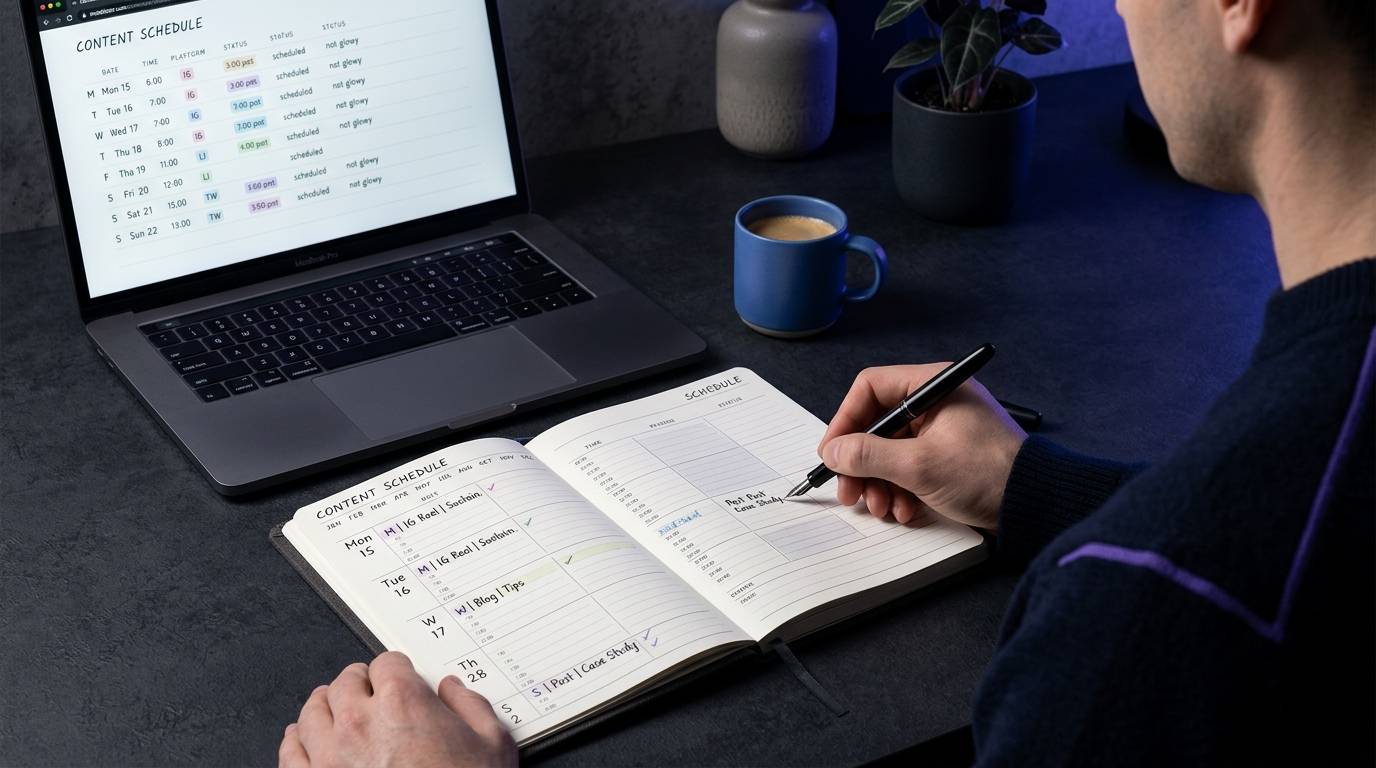
When social media managers search for how often to post, they usually find rigid recommendations. Some guides insist on publishing three times a day, while others suggest five times a week. These generic targets ignore team capacity, content production costs, and audience needs. This guide provides a definitive method for building, testing, and maintaining a publishing schedule that your team can sustain over the long term.
A sustainable social media schedule balances reliable team capacity with audience demand and measurable business objectives. By treating external benchmarks as testable hypotheses rather than mandatory rules, organizations can build a predictable publishing rhythm that protects content quality.
Key Takeaways
- Sustainable publishing requires matching production hours and review workflows to calendar volume, rather than forcing teams to meet arbitrary daily quotas.
- Industry benchmarks reflect broad observations or commercial recommendations, not proven causal formulas for individual account growth.
- Different content formats carry distinct production burdens, meaning a Reel or long video cannot be scheduled at the same frequency as a short text update.
- Cadence experiments must change one variable at a time while measuring both aggregate output and per-post performance.
- A minimum viable schedule provides a defensive baseline that maintains strategic consistency during busy business cycles.
The Structural Difference Between Frequency, Cadence, and Consistency
Social media advice often blurs the lines between frequency, cadence, and consistency. Treating these terms as interchangeable creates operational confusion and leads teams into unsustainable commitments. Establishing clear definitions helps teams plan work with precision.
Posting frequency is the raw count of updates published within a specific timeframe, such as four posts per week. To evaluate frequency accurately, teams must define which formats count toward the total. An Instagram frequency metric that includes feed carousels, Reels, and static images represents a different workload than one that also counts temporary Stories. Defining the exact unit of measurement is essential before setting any volume goals.
Cadence describes the rhythmic distribution of those posts across specific days, channels, and content formats. A brand that publishes three times a week on a dependable Tuesday, Thursday, and Saturday pattern establishes a predictable cadence. Conversely, a brand that publishes three posts within two hours on Monday and remains silent for the rest of the week has the same frequency but an erratic cadence. Cadence governs audience expectations and internal production timelines.
Consistency is the ability to maintain an established cadence over months and quarters without operational collapse. Consistency does not require publishing every single day. Maintaining a disciplined three-day weekly cadence for an entire year builds more audience trust than publishing daily for two weeks and disappearing for a month.
Sustainability is the operational equilibrium where publishing volume does not compromise creative standards or cause team burnout. A study on startup business communications published in Atlantis Press observed positive correlations between posting frequency, content quality, customer interaction, and customer loyalty. However, the study noted that these benefits depend directly on maintaining high content quality rather than prioritizing volume alone. When publishing volume outpaces production capacity, content quality deteriorates, customer interactions decline, and the schedule breaks down.
- CAPACITY AUDIT
- (Labor hours, review bottlenecks, asset availability)
- MINIMUM VIABLE SCHEDULE
- (A dependable baseline cadence per channel)
- CONTROLLED TESTING
- (Test cadence shifts against goal metrics)
- EVALUATION & ADJUSTMENT
- (Assess aggregate yield, per-post yield, cost)
The Limitations of Published Industry Benchmarks
Teams often build their publishing calendars by copying industry benchmark reports. While these reports provide visibility into broad trends, treating them as prescriptive rules is risky. Understanding the research methods behind these numbers helps teams interpret data properly.
Observational studies evaluate existing platform data but do not prove causal relationships. For instance, Buffer analyzed over two million posts from 100,000 Instagram accounts and found that posting three to five times per week was associated with more than double the follower growth rate compared to posting once or twice weekly. The same summary noted that publishing ten times per week was associated with a 24 percent increase in reach per post. However, these figures show correlation, not direct causation. Accounts posting ten times per week often have larger creative teams, stronger brand affinity, or higher production budgets that drive those results.
Account scale also dictates observed posting frequency across platforms. A benchmark study by Later analyzing over 19 million Instagram feed posts showed that publishing habits vary widely by account size. Nano accounts published an average of two feed posts weekly, micro accounts averaged three, and mid-sized accounts averaged five. Later’s analysis of 32,000 Stories revealed that nano accounts averaged three Stories per week, whereas mid-sized accounts averaged fifteen. These data points describe what accounts of different sizes currently do, not what any individual account must do to succeed.
Platform leaders also offer guidance that can differ from third-party studies. In an interview covered by Social Media Examiner, Instagram head Adam Mosseri suggested that posting roughly two feed posts per week and a couple of Stories per day is a healthy baseline. This platform guidance contrasts with commercial guides from Hootsuite, which recommend three to five feed posts weekly for Instagram business profiles. Neither recommendation is universally right or wrong. They simply reflect different perspectives, datasets, and operational goals.
Industry publishing volumes also fluctuate over time. Rival IQ’s Social Media Industry Benchmark Report highlighted that posting frequencies shifted unevenly across networks, increasing slightly on Instagram and TikTok while dropping on Facebook and Twitter. Because platform dynamics shift constantly, teams should view published benchmarks as hypotheses to test rather than fixed requirements.
The Capacity Inventory and the Minimum Viable Schedule
Before drafting a publishing schedule, teams must audit their operational capacity. Setting a schedule based on an idealized sprint inevitably causes missed deadlines and rushed work. A dependable schedule is built on repeatable labor hours.
A comprehensive capacity inventory tracks six core operational components:
- Concept development and copywriting: The time required to research topics, write drafts, and refine messaging for specific platforms.
- Asset creation: The production time needed for graphic design, photography, video capture, editing, audio mixing, and format resizing.
- Review and compliance: The delay between draft completion and stakeholder approval, including legal, brand, or client reviews.
- Technical publishing: The administrative labor of uploading assets, formatting captions, selecting platform settings, and adding follow-up comments.
- Community interaction: The daily time allocated for answering comments, monitoring brand mentions, and participating in platform conversations.
- Tactical buffer: The reserve capacity required to handle unplanned company updates, breaking industry events, or staff absences.
Once the capacity inventory is complete, the team can establish its Minimum Viable Schedule. The Minimum Viable Schedule is the lowest publishing volume that maintains a credible strategic presence on chosen channels while meeting business goals. It acts as an operational safety net during heavy product launches, holiday seasons, or staffing transitions.
To understand how capacity shapes realistic output, consider the production demands of different content formats. A technical, research-backed carousel often requires eight hours of research, drafting, design, and revision. A short text post based on an executive insight may require thirty minutes. A team with ten hours of weekly creative capacity can reliably produce one carousel and four short text posts, or two carousels. They cannot produce five carousels without sacrificing quality or overworking staff.
When teams ignore these production costs, they end up posting low-value filler to meet an arbitrary calendar goal. Using structured weekly content planning keeps teams focused on their capacity constraints before committing to a weekly schedule.
Platform Nuances and Format-Specific Cadences
A publishing schedule must treat every social media network and media format as a distinct operational unit. Blending all channels into a generic weekly target creates planning blind spots. Each platform features distinct distribution mechanics, user consumption patterns, and production requirements.
Instagram Cadence Architecture
Instagram requires teams to manage multiple formats within a single profile, each serving different audience needs. Feed carousels, Reels, static images, and temporary Stories demand separate cadence planning.
- Feed Posts and Reels: Third-party benchmarks from Hootsuite and Buffer suggest three to five feed posts per week as a common test baseline for growth. These formats support audience discovery and non-follower reach through the Explore and Reels algorithms.
- Instagram Stories: Stories are ephemeral assets directed primarily at existing followers. Later’s research indicates that high-output brands post multiple Stories per day to maintain visibility in the top tray. However, small teams can maintain audience connection with three to five structured Story sequences per week.
- Format Balance: Combining feed posts and Stories into a single metric obscures performance. A team publishing three Reels and ten Stories per week is executing two distinct cadences that require different tracking methods.
LinkedIn Cadence Architecture
LinkedIn’s professional feed prioritizes topical relevance, professional authority, and member commentary over high-frequency publishing. The platform supports text posts, image documents, short videos, and long-form articles.
- Creator and Company Recommendations: LinkedIn’s published creator resources suggest starting with two posts per week and scaling up as capacity allows. Other LinkedIn marketing guides cite two to five posts per week as an effective range for building consistent engagement.
- Post Longevity: High-performing LinkedIn posts often generate impressions and comments for forty-eight to seventy-two hours. Publishing multiple updates daily can cause an account’s posts to compete against each other for feed distribution.
- Focus on Substance: LinkedIn guidance repeatedly emphasizes depth and domain expertise over volume. A well-argued industry analysis published twice weekly consistently outperforms daily surface-level observations.
TikTok and Video-First Platforms
Short-form video platforms operate under algorithmic distribution systems where production volume and creative testing play a major role.
- Publishing Recommendations: Hootsuite’s cross-platform schedule guide recommends three to five posts per week on TikTok as a sustainable baseline for businesses. While high-volume creators often post multiple times daily, brands must evaluate whether their video production capacity can support that pace.
- Video Production Demands: Video assets require lighting, filming, editing, and sound design. If a team cannot maintain high production standards at daily volumes, reducing frequency to three polished videos per week is a better strategic choice.
Facebook, X, and Pinterest Considerations
Mature platforms feature diverse user habits and distribution lifecycles that dictate posting rhythms.
- Facebook Pages: Hootsuite suggests one to two posts daily for Facebook Pages. However, organic reach constraints mean that businesses should prioritize high-engagement community posts over high-frequency generic updates.
- X (formerly Twitter): The fast-moving nature of X has historically supported higher publishing volumes of two to three posts daily. Teams must balance this output against the capacity needed to participate in real-time conversations.
- Pinterest: Pinterest functions more like a visual search engine than a social feed, with pins maintaining discovery value for months. Hootsuite suggests pinning at least once weekly, though successful catalog management often involves regular batch scheduling of themed boards.
When coordinating multiple channels, teams benefit from a centralized social media calendar that shows every format across all destinations in one place.
A Six-Step Operating Framework for Sustainable Scheduling
Building a sustainable posting schedule requires an iterative workflow. Rather than guessing a target frequency, teams should follow a structured method to define, deploy, and evaluate their publishing rhythm.
- Step 1: Define Channel Objectives
- Step 2: Establish a Performance Baseline
- Step 3: Map Format-Specific Production Capacity
- Step 4: Select an Initial Cadence Hypothesis
- Step 5: Execute a Controlled Cadence Experiment
- Step 6: Evaluate Output, Yield, and Resource Costs
Step 1: Define the Specific Objective for Each Channel
Every platform in your mix must have a clear business purpose. Without a defined objective, you cannot determine whether a posting schedule is working.
- Discovery Channels: Platforms like TikTok, Instagram Reels, or YouTube Shorts might focus on non-follower reach and brand awareness.
- Consideration Channels: Networks like LinkedIn or specialized Facebook Groups might focus on thought leadership, qualified website clicks, or newsletter signups.
- Retention and Support Channels: Accounts on X or Facebook might handle direct customer questions and community discussions.
Write down the primary metric for each channel, such as qualified website visits, engagement rate, or follower growth. This objective dictates the content formats and publishing cadence you need.
Step 2: Establish a Controlled Performance Baseline
Before changing your publishing frequency, document your current performance metrics over a four-to-six-week period. This baseline provides the standard against which all future cadence adjustments will be measured.
Track the following baseline variables for each platform:
- Average number of posts published per week, broken down by format.
- Total aggregate reach, impressions, and engagement metrics.
- Average per-post reach, impressions, and engagement metrics.
- Total inbound clicks, conversions, or target business actions.
- Average labor hours invested in weekly content production and community management.
Step 3: Map Content Themes to Production Workflows
Organize your content into recurring topical themes that streamline production. Recurring themes reduce creative fatigue by providing clear parameters for each post.
- Theme A (Educational): In-depth tutorials, industry teardowns, or technical frameworks.
- Theme B (Social Proof): Customer case studies, community highlights, or user-generated assets.
- Theme C (Company Updates): Product releases, company culture updates, or event announcements.
- Theme D (Conversational): Polls, direct questions, or open commentary on industry news.
Assign specific formats to these themes and verify that each has a reliable source of raw material. This structure makes production predictable and repeatable.
Step 4: Select an Initial Cadence Hypothesis
Select a starting posting frequency for each platform based on your capacity audit and industry benchmarks. Treat this starting point as a clear hypothesis.
For example, your hypothesis might state: “Publishing three high-quality LinkedIn posts per week will generate more qualified clicks than publishing five rushed posts, while staying within our six-hour weekly production limit.”
Ensure this starting cadence matches your Minimum Viable Schedule. It is far better to begin with a modest schedule and expand later than to start too aggressively and miss deadlines.
Step 5: Execute a Controlled Cadence Experiment
Run your selected cadence for at least four to six weeks without altering other key strategic variables. Changing post volume, target audience, visual design, and publishing times simultaneously makes it impossible to determine what caused any change in results.
During the test window, log every published post, its format, release time, and production hours. Ensure your team maintains community response protocols during this period so audience engagement is fully captured.
Step 6: Evaluate Aggregate Output, Per-Post Yield, and Labor Cost
At the end of the test period, compare the experimental data against your baseline. A balanced evaluation looks at both total output and unit efficiency.
- Aggregate Yield: Did total reach, clicks, and conversions increase during the test period?
- Per-Post Yield: Did individual posts perform better, stay steady, or decline in average reach and engagement?
- Cost-to-Outcome Ratio: How many additional production hours were required to generate the observed gains?
- Creative Sustainability: Did the team meet all deadlines comfortably, or did the cadence cause burnout and compromised quality?
If total results increased while production costs remained manageable and per-post yield stayed healthy, the new cadence is sustainable. If per-post reach dropped sharply and team hours surged with little aggregate gain, return to the lower frequency.
Strategic Content Distribution and Repurposing Architecture
A sustainable schedule does not require generating every post from scratch. High-output teams use structured repurposing workflows to turn one core concept into multiple platform-native assets.
A repurposing architecture separates idea generation from asset formatting. A single comprehensive asset, like a research report, webinar, or technical guide, serves as the foundation for multiple social updates across different channels.
- CORE SOURCE ASSET
- (Webinar, research report, whitepaper)
- v v v
- LINKEDIN POST INSTAGRAM SHORT
- (Data analysis CAROUSEL VIDEO
- and takeaways) (Key graphics) (Core insight)
Consider this practical repurposing workflow:
- Foundation Asset: A 1,500-word engineering case study published on the company website.
- LinkedIn Post: A breakdown of the three main architectural challenges and solutions, formatted as a text update with a summary document.
- Instagram Carousel: An eight-slide visual graphic showing the system architecture, key metrics, and implementation steps.
- Short-Form Video: A sixty-second interview clip with the lead engineer explaining the most surprising lesson from the project.
- Text Updates: Three short standalone tips highlighting specific data points from the study, published over two weeks.
This repurposing model turns a single research effort into six distinct social media assets. It populates a multi-channel calendar for two weeks while keeping creative production costs low.
When managing repurposing workflows across different channels, teams need reliable social media publishing tools to organize platform-specific drafts and assets.
Operational Pitfalls in Cadence Management
Building a sustainable posting schedule requires avoiding common strategic mistakes. Many teams fall into workflow traps that create unnecessary stress and dilute content performance.
Treating All Platforms as a Unified Queue
A frequent operational mistake is applying a single publishing schedule across all social networks. Publishing three times a day because X supports that volume will overwhelm your LinkedIn audience and exhaust your creative team. Each network requires its own cadence based on platform dynamics and audience expectations.
Falling into the Batch-and-Abandon Trap
Scheduling content weeks in advance creates operational efficiency, but abandoning the calendar after scheduling undermines results. Social media platforms reward authentic community interaction. LinkedIn’s platform guidance stresses the value of meaningful conversations in comments, while Rival IQ calculates engagement rates based on active user interactions. A schedule must allocate time for responding to comments and engaging with peer accounts, not just automated publishing.
Mistaking Campaign Bursts for Baseline Capacity
During a major product launch or seasonal campaign, marketing teams often increase their output to publish multiple updates daily. Operating in a short-term campaign sprint is normal, but treating that temporary volume as a permanent baseline leads to burnout. Teams must distinguish between temporary campaign cadences and regular baseline operations.
Comparing Incompatible Engagement Metrics
Evaluating schedule performance requires consistent metric definitions. Rival IQ defines engagement rate by dividing total interactions (likes, comments, shares, and reactions) by follower count. Conversely, Buffer’s Instagram benchmark models calculate engagement using likes, comments, and saves relative to reach or impressions. Comparing performance across different tools or platforms without accounting for these metric definitions will distort your analysis. For a deeper understanding of metric interpretation, read our guide on evaluating social analytics with proper context.
- ENGAGEMENT RATE DEFINITION COMPARISON
- Rival IQ Formula
- (Likes Comments Shares Reactions) / Total Followers
- Buffer Instagram Benchmark Formula
- (Likes Comments Saves) / Reach or Impressions
- Takeaway: Never compare rates calculated on different formulas.
Adding Volume to Fix Weak Performance
When engagement drops, teams often assume they need to post more frequently to regain visibility. However, increasing frequency when content is not resonating simply delivers more low-performing posts to your audience. When performance declines, the right response is to pause, audit content quality, and refine your core message before changing publishing volume.
Illustrative Cadence Models Across Team Scales
To understand how capacity and strategy align in practice, review these three illustrative models. These scenarios demonstrate how different organizations balance production limits with platform requirements.
Model 1: The Specialist Creator or Solo Operator
This model represents a solo consultant, technical expert, or independent creator managing their own publishing with roughly four to five hours of weekly marketing capacity.
- Primary Channel: LinkedIn (personal profile).
- Secondary Channel: X (industry networking).
- Minimum Viable Schedule: Two high-value LinkedIn text updates and three short X posts per week.
- Weekly Production Workflow:
- Monday: Review notes, industry reading, and outline two core ideas (1 hour).
- Tuesday: Draft and schedule LinkedIn posts for Wednesday and Friday (1.5 hours).
- Wednesday through Friday: Spend fifteen minutes daily responding to comments and posting on X (1.5 hours total).
- Strategic Rationale: This modest cadence protects the operator’s client delivery time while maintaining a consistent, high-value professional presence.
Model 2: The Small In-House Marketing Team
This model represents a two-person marketing team supporting a growing B2B software company, with approximately fifteen hours of weekly social production capacity.
- Primary Channels: LinkedIn (Company Page), YouTube Shorts.
- Secondary Channel: Instagram (employer branding and culture).
- Minimum Viable Schedule: Three LinkedIn posts, two YouTube Shorts, and two Instagram feed updates per week.
- Weekly Production Workflow:
- Monday: Content ideation, outline review, and script drafting (3 hours).
- Tuesday: Film video assets and draft LinkedIn copy (4 hours).
- Wednesday: Video editing, graphic design, and internal reviews (4 hours).
- Thursday: Final approvals, asset scheduling, and caption formatting (2 hours).
- Daily: Active community monitoring and conversation management (2 hours total).
- Strategic Rationale: By using a structured production schedule, this small team maintains consistent output across three distinct formats without overextending internal resources.
Model 3: The Multi-Brand Agency or Enterprise Team
This model represents a dedicated social media manager overseeing multiple brand accounts or client profiles within an agency environment.
- Primary Channels: Instagram, TikTok, LinkedIn, Facebook Pages across three brand properties.
- Minimum Viable Schedule: Four feed posts and daily Stories on Instagram, four TikTok videos, and three LinkedIn updates per brand weekly.
- Weekly Production Workflow:
- Week 1 of Month: Batch strategy, asset production, and copy development for the upcoming month.
- Week 2 of Month: Stakeholder and client approval rounds, followed by revisions.
- Week 3 of Month: Final scheduling, tagging, and format-specific optimization across all destinations.
- Ongoing Daily: Real-time community engagement, social listening, and reactive publishing.
- Strategic Rationale: Enterprise scale requires decoupling content creation from daily publishing through monthly batching and structured review cycles. Teams managing this volume benefit from specialized workflows for managing multiple social accounts across brands.
Cadence Evaluation and Adjustment Protocol
A publishing cadence is not static. It requires periodic review to ensure it continues to serve business goals as algorithms change and teams evolve.
Teams should conduct a formal cadence audit every ninety days using this evaluation framework:
Cadence Audit Criteria
- Objective Alignment: Are target metrics (leads, traffic, reach) trending in the right direction under the current cadence?
- Production Health: Did the team hit at least 90 percent of scheduled publishing slots on time over the past quarter?
- Quality Consistency: Did engagement per post remain steady as volume changed, or did higher frequency dilute content quality?
- Team Sustainable Capacity: Did team members report manageable workloads, or did publishing cause persistent operational bottlenecks?
- 90-DAY AUDIT SIGNALS
- INCREASE Cadence If
- Consistent backlog of unreleased high-value assets
- Team finishes production ahead of schedule
- Per-post engagement remains high and steady
- DECREASE Cadence If
- Deadlines are missed regularly
- Per-post reach drops significantly without aggregate gain
- Community management and replies are neglected
- PAUSE Cadence If
- Company enters a major operational crisis
- Core messaging strategy is undergoing a complete pivot
Deciding When to Adjust Cadence
Use these clear operational indicators to guide your schedule adjustments:
- When to Increase Cadence: Increase publishing frequency only when your team has a consistent backlog of unused, high-value content ideas, production hours are comfortably below weekly limits, and per-post engagement rates remain healthy. Add one weekly post per platform at a time and evaluate the impact over four weeks.
- When to Decrease Cadence: Reduce publishing frequency immediately if deadlines are consistently missed, posts are assembled hurriedly to meet arbitrary quotas, per-post engagement drops sharply, or community management is neglected. Dropping frequency relieves operational pressure and restores content quality.
- When to Pause Publishing: Temporarily pause scheduled publishing during major company crises, unexpected brand emergencies, or wholesale strategic pivots. Pushing scheduled marketing updates during an active crisis damages brand credibility.
Implementation Checklist and Next Steps
Use this practical checklist to audit your current social media workflow and establish a sustainable publishing schedule over the coming week.
Phase 1: Capacity and Baseline Audit (Days 1 to 2)
- Log total available labor hours for all team members involved in social content creation, review, and publishing.
- Calculate the average production time required for each format your team creates (text updates, carousels, short videos, Stories).
- Document current 30-day baseline performance across all active channels, recording both aggregate and per-post metrics.
- Identify approval bottlenecks and document the average turnaround time required for stakeholder reviews.
Phase 2: Schedule Design and Channel Strategy (Days 3 to 4)
- Write down a clear business objective and primary target metric for each active platform.
- Define your team’s Minimum Viable Schedule for each channel to serve as an operational safety baseline.
- Establish three to five recurring content themes to structure weekly idea generation and asset drafting.
- Create a single weekly calendar template that maps themes and formats to specific days and times.
Phase 3: Deployment and Controlled Testing (Days 5 to 7)
- Draft, review, and schedule the first two weeks of content in advance using your established capacity limits.
- Block dedicated daily calendar time for active community engagement and conversation management.
- Set a calendar reminder four weeks out to conduct your first cadence performance review.
- Review results after thirty days, comparing aggregate yield, per-post yield, and production hours against your baseline.
Sources
- 2024 Social Media Industry Benchmark Report
- The Influence of Visual Content, Posting Frequency, and User …
- How often should a business post on social media? (2025 …
- Repurpose Content
- How to Determine Your Ideal Instagram Posting Frequency
- How Often to Post on Social Media in 2026 — Data-Backed …
- How to create a social media posting schedule in 2026
- Professional LinkedIn Posting Best Practices
- Posting Frequency for Better LinkedIn Engagement
- Tips for Consistent Posting to Drive Growth
- How Often Should You Post on Instagram in 2026? What Data From …
- Download the 2024 Social Media Industry Benchmark Report
- 2026 Social Media Benchmarks to Guide Your Strategy - Buffer
- Social media calendar: Top tools and templates for 2026