Can I legally repost this photo or audio track on our company social media accounts? Social media managers and content operations teams type variations of this exact question into search engines every single week. This guide provides the definitive answer, establishing a structured rights verification checklist that eliminates legal exposure, account penalties, and unforced takedowns before you schedule your next post.
Publishing social media assets without explicit, use-specific authorization introduces severe operational vulnerabilities, potential copyright infringement claims, and brand damage. This resource provides a practical framework to audit ownership, secure commercial licenses, verify likeness consent, and maintain clean audit trails across every digital channel.
Key Takeaways
- Public availability on a platform does not equal permission for third-party commercial reuse or off-platform distribution.
- Copyright ownership, commercial licensing, and individual likeness rights represent three separate legal layers that require individual verification.
- Music clearance requires distinct rights for both the underlying composition and the specific sound recording.
- Fair use is never guaranteed by short duration, creator attribution, or non-profit status.
- A robust rights ledger must capture exact asset identifiers, license scopes, geographic territories, authorized channels, and expiration dates.
The Core Architecture of Social Media Copyright and Ownership
Every piece of digital media begins with an author. In the realm of statutory copyright law, copyright protection automatically attaches the moment an original work of authorship is fixed in a tangible medium of expression. Registration provides substantial benefits for enforcement in court, but fixation alone creates immediate legal ownership.
The person who presses the camera shutter button or records the video clip is almost always the initial copyright owner. A widespread misconception in social media management assumes that holding physical possession of a digital file grants publishing authority. Possession is not ownership. Similarly, being the subject depicted inside a photo does not grant you the right to distribute that image. The photographer retains the copyright unless an explicit written agreement transfers those rights.
- Asset Creation: Fixation in Tangible Form
- Independent Creator
- Employee in Scope of Work
- Holds Initial Rights
- Employer Holds Initial Rights
- Requires Express Written Grant for Commercial Reuse
Corporate ownership exceptions depend on strict legal standards. Under work-made-for-hire doctrines, an employer automatically owns the copyright created by an employee if the creation occurred within the regular scope of employment. Independent contractor agreements do not automatically grant work-made-for-hire status simply because an invoice was paid. Without a written agreement that explicitly assigns copyright or designates the deliverable as a work made for hire under applicable statutory categories, the independent freelancer retains ownership.
Social media teams must trace every asset back to its legal author. When acquiring assets from influencers, agencies, or external partners, teams must verify that the grantor possesses actual authority to license the content. If an agency provides user-generated content, you must confirm that the agency secured verifiable written assignments from the original creators. Relying on informal verbal assurances leaves your organization directly liable for statutory infringement.
Clearance Layers for Visual and Audiovisual Media
Clearing a multimedia post requires auditing multiple distinct layers of legal rights. A single video clip often contains distinct layers of intellectual property, proprietary branding, and individual privacy rights. Overlooking any single layer exposes the entire publication to takedown requests or civil litigation.
The first layer covers visual copyright. This includes the camera footage, still photographs, motion graphics, and digital illustrations contained within the asset. You must confirm that every visual component is either created in-house by employees, properly assigned via contract, or licensed through a reputable commercial stock repository.
- Visual Media Clearance Stack
-
- Visual Copyright (Footage, Photos, Illustrations, Graphics)
-
- Audio Copyright (Sound Recording Master, Underlying Composition)
-
- Likeness and Publicity Rights (Identifiable Faces, Voices, Names)
-
- Trademark and Proprietary Property (Visible Logos, Private Architecture)
The second layer governs rights of privacy and publicity. Independent of copyright, individuals possess statutory and common-law rights controlling how their name, image, portrait, voice, and likeness are exploited for commercial purposes. For instance, statutory law in jurisdictions like New York expressly prohibits using a living person’s name, portrait, picture, or voice for advertising or trade purposes without prior written consent. A photographer may hold copyright to an image, yet that photographer cannot authorize your brand to use the image in a promotional campaign if the identifiable subject never signed a commercial model release.
The third layer involves proprietary trademarks and private property. Backgrounds containing prominent corporate logos, copyrighted artworks hanging in private spaces, or distinctive architectural designs can trigger secondary claims. When planning promotional campaigns with a campaign launch planner, teams must establish a routine asset audit to flag and clear these background elements before scheduling.
Music Licensing Complexities in Commercial Channels
Music licensing represents one of the most hazardous areas of social media publishing. Modern social platforms offer vast libraries of popular songs, leading brand managers to assume that any track accessible within an application is safe for business use. This assumption routinely results in muted videos, copyright strikes, and costly licensing demands.
A commercial musical work consists of two separate copyrights. First, the musical composition includes the notes, chords, and written lyrics created by the songwriters and composers. Second, the sound recording, or master, represents the specific audio performance captured by recording artists and owned by a record label. To use commercial music in video content, a publisher must secure both synchronization rights for the composition and master-use rights for the recording.
- Musical Work Structure
- Musical Work
- Musical Composition
- Sound Recording
- Lyrics, melody, score - The recorded performance
- Controlled by publishers - Controlled by record labels
- Requires Synchronization Right - Requires Master-Use Right
Performance rights organizations like ASCAP license non-dramatic public performance rights for musical works. However, performance rights organizations repeatedly state that their general performance licenses do not include synchronization or master-use rights for pairing music with visuals in marketing campaigns. Those rights must be negotiated directly with music publishers and record labels, or secured through dedicated commercial production libraries.
Platform-provided consumer audio libraries operate under restrictive platform agreements that exclude commercial activity. TikTok, for instance, maintains separate consumer and commercial tracks. TikTok explicitly notes that standard music licenses do not cover commercial activity, directing businesses and marketing campaigns to its Commercial Music Library. Using consumer-cleared trending sounds on a corporate profile violates platform terms of service and infringes the copyright owners’ exclusive rights.
Statutory Fair Use and Creative Commons Parameters
Fair use is frequently misunderstood as an absolute shield for social media content. Marketing teams often attempt to justify unauthorized clips by citing short durations, adding on-screen credit, or claiming educational intent. These justifications have no basis in statutory copyright law.
Under Section 107 of Title 17 of the United States Code, fair use is an affirmative defense evaluated through a rigorous four-factor statutory analysis. No single factor decides the outcome. The statutory factors require examining:
- The purpose and character of the use, including whether the use is commercial or transformative.
- The nature of the copyrighted work, distinguishing factual works from highly creative works.
- The amount and substantiality of the portion used in relation to the copyrighted work as a whole.
- The effect of the use upon the potential market for or value of the copyrighted work.
The U.S. Copyright Office emphasizes that there is no specific number of words, video seconds, or musical notes that automatically qualifies as fair use. A five-second clip of a pivotal scene in a commercial product teaser can still constitute infringement if it exploits the creative heart of the work. Transforming an asset requires adding new meaning, commentary, or critical insight. Simply overlaying a corporate logo or product graphic onto another creator’s video does not constitute transformative fair use.
- The Four Fair Use Factors (17 U.S.C. § 107)
-
- Purpose & Character: Is the use transformative or purely commercial?
-
- Nature of the Work: Is the original factual or deeply creative?
-
- Amount & Substantiality: Was the quantitative or qualitative core taken?
-
- Market Effect: Does the use damage the market for the original work?
Creative Commons licenses offer standard frameworks for permissions, but they contain strict, binding conditions. A generic Creative Commons tag does not grant unrestricted freedom for commercial promotion. Creative Commons licenses incorporate specific condition codes:
- Attribution (BY): You must provide appropriate credit, supply a link to the license, and indicate if changes were made.
- NonCommercial (NC): You cannot use the material for commercial advantage or monetary compensation, which excludes brand promotion.
- NoDerivatives (ND): If you remix, transform, or build upon the material, you may not distribute the modified material.
- ShareAlike (SA): If you remix or alter the material, you must distribute your contributions under the exact same license.
An asset licensed under CC BY-NC-ND cannot be used in a corporate campaign, cropped to fit vertical formats, or published on a branded account. Teams must verify the exact Creative Commons tier before downloading or editing any open-source media asset.
Step-by-Step Verification Protocol for Publishing Teams
To prevent unauthorized material from reaching production, marketing organizations require a reliable verification workflow. This step-by-step process integrates directly into your daily content pipeline. It provides clear checkpoints from ideation to final scheduling.
- Verification Protocol Sequence
-
- Inventory
-
- Trace Origin
-
- Scope Check
-
- Audio/Likeness
-
- Log & Schedule
1. Document the Proposed Asset Inventory
Catalog every individual element inside the proposed post before beginning creative production. List the core video file, background audio, static imagery, graphic overlays, and text quotes. Record where each item originated, whether from internal production, an influencer partner, a stock agency, or a customer submission. Maintaining a weekly social content planning checklist helps teams identify asset sources well before deadlines arrive.
2. Verify Creator Identity and Legal Authority
Determine who created each component and whether they hold the legal authority to grant usage permissions. If the asset comes from an employee, verify that it was created within their standard employment duties. If the asset comes from an independent contractor or influencer, inspect the signed agreement to confirm an explicit assignment of rights or a broad commercial license. If an asset is provided by a brand partner, obtain written confirmation that they own the content.
3. Define the Precise Commercial Scope
Define exactly how, where, and how long the content will be displayed. Usage rights are rarely universal. Your documentation must specify whether the permission covers organic social posts, paid advertising amplification, website embedding, or physical display. Document the authorized digital channels, geographic territories, and the exact expiration date of the grant.
- Scope Specification Checklist
- Placement Type: Organic feed, paid advertising, story, or profile header.
- Distribution Networks: Specific platforms and profile types.
- Geographic Territories: Worldwide or specific regional markets.
- Duration Limits: Fixed campaign window or perpetual archival rights.
- Modification Scope: Authorization to crop, edit, translate, or remix.
4. Execute Secondary Audio and Likeness Clearances
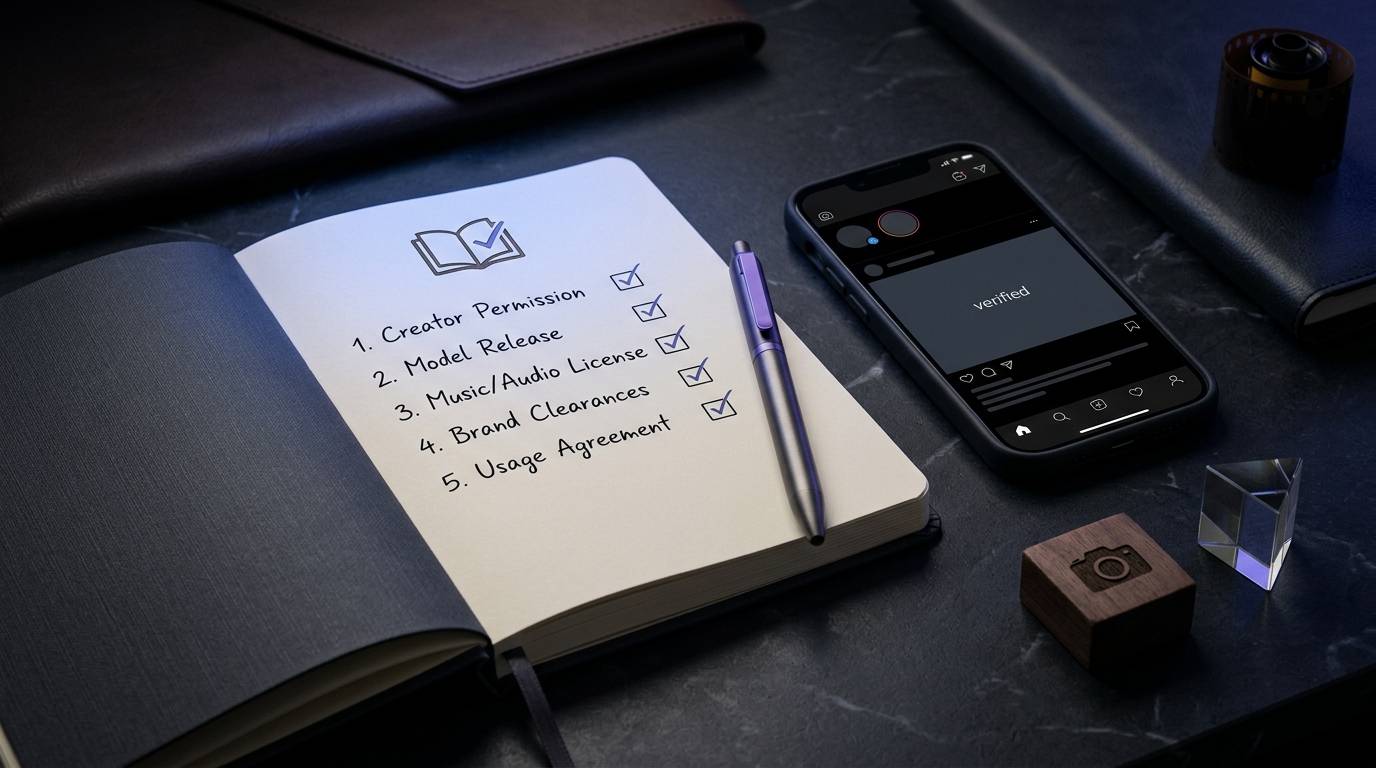
Perform a dedicated clearance check on background music, sound effects, and human subjects. Ensure that music files come from verified commercial libraries or direct sync and master agreements. Verify that every identifiable person featured in the visual media has executed a written model release covering commercial advertising. If minors appear in the content, confirm that written consent was executed by a parent or legal guardian.
5. Compile the Audit Record and Approve
Gather all signed contracts, stock license receipts, model releases, and written permissions into a centralized repository. Assign a unique rights clearance identifier to the asset. Only after the audit record is validated should the asset move into your structured publishing workspace for final scheduling and automated distribution.
Operational Pitfalls and Platform Traps
Content teams regularly encounter operational scenarios where permissions appear valid on the surface but fail under legal scrutiny. Recognizing these common traps protects your organization from unexpected liability and costly takedown notices.
The Repost Fallacy
A customer posts a photograph featuring your product on an open profile and tags your brand handle. Marketing teams frequently assume this public interaction permits downloading the file and uploading it to the brand’s primary channel. This assumption is incorrect.
The customer retains the underlying copyright in their original photograph. By tagging your handle or using your branded hashtag, the user does not automatically transfer copyright or grant an unrestricted commercial license. Reposting the asset natively using platform share functions generally complies with platform terms of service. However, downloading the original file and re-uploading it as native brand content requires express written permission and a signed likeness release from every individual depicted.
- Public Customer Post on Social Media
- Native Platform Share
- Download & Re-upload
- Allowed under platform TOS - Creates new native copy
- Retains original context - Requires written copyright license
- Does not create liability - Requires written model releases
The Trending Audio Illusion
Short-form video platforms thrive on viral audio clips and trending cultural sounds. Social media teams often believe that if an audio track trends within the mobile application, any account may use it to boost reach.
Consumer audio access is subsidized by platform-level licenses that strictly exclude commercial entities, corporate accounts, and promotional marketing. When a brand profile uses a trending commercial pop song, the brand commits copyright infringement. Platforms actively deploy automated audio fingerprinting systems to mute unverified commercial posts, apply strikes to brand accounts, or restrict account functionality.
The Derivative Crop Trap
A design team sources a photograph covered by a permissive stock license and crops out the background, adds brand typography, and changes the color grading. If the underlying license contains a NoDerivatives (ND) restriction, this editing process violates the contract.
Modifying, remixing, or altering an asset creates a derivative work. You must confirm that your asset license explicitly permits modifications, adaptations, and commercial derivative works before altering source imagery for multi-channel campaigns.
The Missing Influencer Flow-Down
A company hires an influencer to produce three short-form videos promoting a product launch. The influencer incorporates popular commercial music and features friends in the background. The brand then uses the completed video in paid social ad placements.
The brand faces immediate exposure on two fronts. First, the influencer’s personal platform agreement does not extend sync rights for commercial advertising to the brand. Second, the background individuals never signed commercial model releases with the corporate sponsor. Influencer agreements must explicitly require the creator to deliver fully cleared assets, complete with verified commercial audio licenses and signed third-party releases.
Platform-Specific Enforcement and Syndication Nuances
Social networks operate complex, automated intellectual property enforcement engines under the Digital Millennium Copyright Act and international copyright laws. Understanding how individual networks manage rights claims ensures your multi-channel syndication strategy remains stable and uninterrupted.
- Platform Rights Management Engines
- Platform Core Rights Mechanism & Commercial Rule
- YouTube Content ID audio/visual fingerprinting; strict strikes
- TikTok Commercial Music Library required for brand accounts
- Meta Rights Manager automated matching across FB & IG
- Pinterest Visual matching and standard DMCA notice systems
- LinkedIn Direct manual DMCA reporting and member notifications
YouTube Content ID and Copyright Strikes
YouTube operates the Content ID system, an automated fingerprinting engine that scans uploaded video against a database of files submitted by copyright owners. When a match occurs, the copyright owner can choose to block the video, monetize it by running ads, or track its viewership statistics.
Receiving a Content ID claim is different from receiving a formal DMCA copyright strike. A Content ID claim alters monetization or visibility, while a formal copyright strike serves as a legal notice of infringement. Accumulating three copyright strikes results in permanent channel termination, removal of all uploaded videos, and a ban on creating future channels. Publishing identical content across multiple brand channels requires ensuring that every destination account is whitelisted by your licensing partners.
Meta Rights Manager for Facebook and Instagram
Meta utilizes Rights Manager to identify copyrighted audio and video across Facebook and Instagram. Rights Manager enables rights holders to set automated rules that instantly block matching uploads, mute audio segments, or monitor publication performance across pages.
When managing multiple brand accounts, content teams must recognize that music cleared for an organic Instagram Reel is not automatically cleared for a Facebook Page post. Cross-posting tools must account for destination-specific rights. If you schedule a campaign across multiple networks, verify that your audio licenses cover cross-platform distribution.
TikTok Commercial Ecosystem Rules
TikTok enforces a strict divide between personal creator accounts and commercial business accounts. Business accounts are restricted from accessing the general sound library containing licensed popular music. Instead, business accounts are restricted to the Commercial Music Library, which contains pre-cleared, royalty-free tracks for business use.
Attempting to bypass these restrictions by uploading proprietary edits containing uncleared commercial music risks immediate account suspension. TikTok’s automated moderation detects unlicensed tracks and silences the video. This nullifies your production investment and impairs campaign distribution.
Syndication Across LinkedIn, X, and Pinterest
Platforms like LinkedIn, X, and Pinterest rely primarily on standard DMCA takedown procedures and direct rights-holder reporting. While automated real-time matching may be less visible during the initial upload, manual enforcement can carry severe consequences.
Corporate brands on LinkedIn face elevated exposure due to the platform’s strictly professional context. Using an unauthorized photograph or quote in a corporate post can directly trigger executive-level infringement notices and public legal disputes. Ensure that all quote attributions and visual assets syndicated to professional networks are supported by complete documentation.
Architecture of an Internal Rights Ledger
To manage digital assets across distributed teams without administrative confusion, organizations must maintain an internal rights ledger. This structured database tracks every creative asset, its legal permissions, and its operational constraints.
- Rights Ledger Architecture
- Asset Record
- Asset ID & Canonical File Name
- Source Type (Employee, Vendor, Stock, Influencer)
- Original Creator & Contact Information
- Verified Ownership Basis (W-2, Assignment, License)
- Permitted Placement (Organic, Paid, Multi-Platform)
- Geographic Scope & Expiration Date
- Associated Likeness Releases & Music Sync IDs
- Storage URL for Raw Executed Legal Agreements
A well-architected rights ledger integrates directly with your centralized content calendar. Before any asset is attached to a scheduled publishing slot, the content manager cross-references the asset ID in the rights ledger. If the asset lacks verified documentation, or if the planned publication date extends beyond the license expiration window, the asset is flagged and held.
The rights ledger must record exact attribution text when required by Creative Commons or custom vendor agreements. Missing required credit notices breaches the underlying contract, instantly voiding your usage rights and exposing the brand to infringement claims.
- Sample Rights Ledger Entry
- Asset Identifier: VID-2024-Q3-088
- Description: 30-second product demo video in vertical orientation
- Copyright Owner: Horizon Media Production LLC
- Acquisition Type: Work-for-hire contractor agreement
- Signed Agreement Reference: CONTRACTS/2024/HMP-088-ASSIGN.pdf
- Likeness Clearances: 2 signed model releases on file (REF: MR-104, MR-105)
- Audio Asset ID: CML-TIKTOK-TRACK-99412
- Audio License Type: Commercial Music Library (Pre-cleared)
- Permitted Channels: TikTok, Instagram Reels, YouTube Shorts
- Usage Scope: Organic feed and paid social amplification
- Geographic Territory: Worldwide
- License Expiration: September 30, 2025
- Mandatory Credit: None required
- Review Status: Fully Cleared by Legal Operations
Maintaining this rigorous record structure guarantees operational continuity. If an agency relationship ends, an influencer disputes usage, or a team member departs, the brand retains clear, permanent evidence of its publishing permissions.
Practical Action Plan for Content Operations
Implementing a rights verification framework requires establishing structured habits across your daily editorial workflow. Apply this practical checklist this week to protect your publishing schedule and eliminate compliance risks.
Immediate Weekly Execution Steps
- Audit your upcoming 14-day publishing queue across all channels to identify any user-generated content, trending audio, or external stock photos lacking signed documentation.
- Establish a centralized permissions directory to store signed model releases, influencer contracts, and stock licensing invoices.
- Transition all corporate social profiles on short-form video platforms to verified business accounts, ensuring your team only selects audio from commercial libraries.
- Implement a mandatory asset logging rule that requires attaching a rights ledger ID to every scheduled draft before final editorial sign-off.
- Conduct a briefing with your creative team and agency partners to review the boundaries of fair use, likeness consent, and derivative modifications.
Operating a calm, predictable social media presence requires eliminating unforced legal risks. By enforcing this systematic rights checklist across your content operations, your team can publish creative campaigns with absolute confidence, clarity, and control.
Sources
- About the Commercial Music Library
- Music Rights Management on YouTube
- Restrictions on claimed music - YouTube Help
- Section 512 of Title 17: Resources on Online Service …
- ASCAP’s Website & Mobile App Music License
- ASCAP Music Licensing FAQs
- 17 U.S. Code § 107 - Limitations on exclusive rights: Fair use
- LibGuides: Copyright: Copyright Term and the Public Domain